
Standby batteries · Series, part 7
Voice alarm panels can cry wolf and still miss real faults
False faults, missed faults, and what to ask whoever maintains your voice alarm.
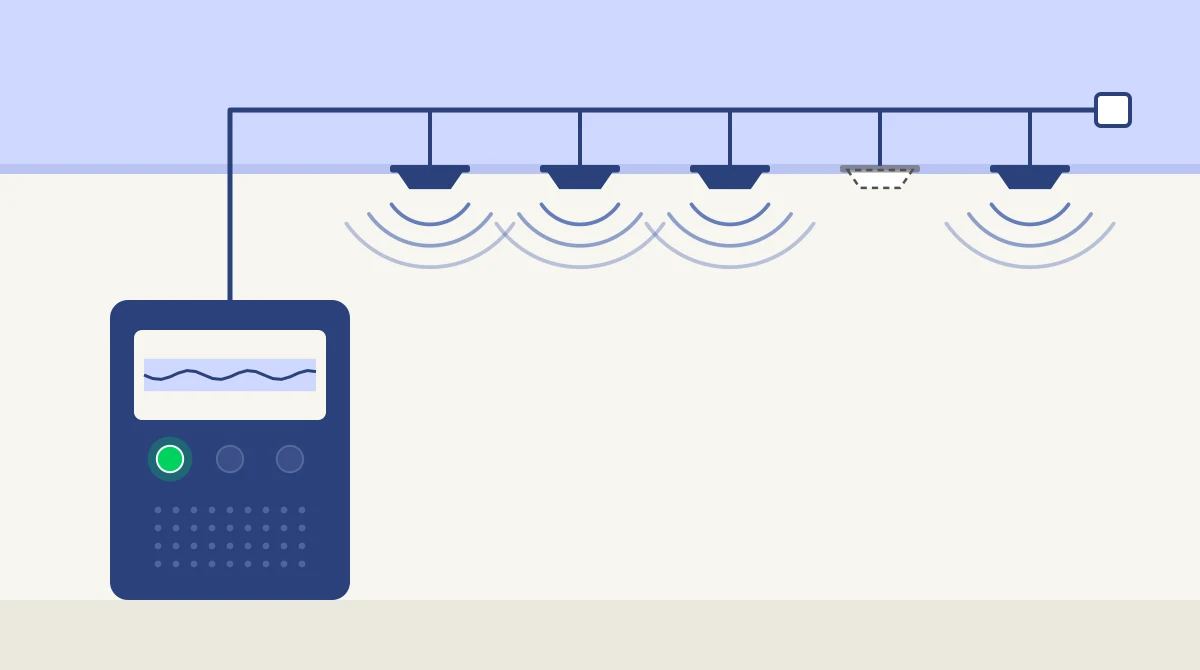
Between November 1999 and July 2000 the United States military flew the V-22 Osprey through its operational evaluation: 804 flight hours, 522 sorties. The aircraft carried an electronic watchman, automated diagnostics supervising its systems for faults. The evaluators found that the watchman met its targets for catching and naming faults. It also raised so many false ones that they judged the entire automated diagnostic capability to be of little or no value.
An aircraft can have a watchman less reliable than the thing it watches. So can a building.
What does a voice alarm panel actually watch?
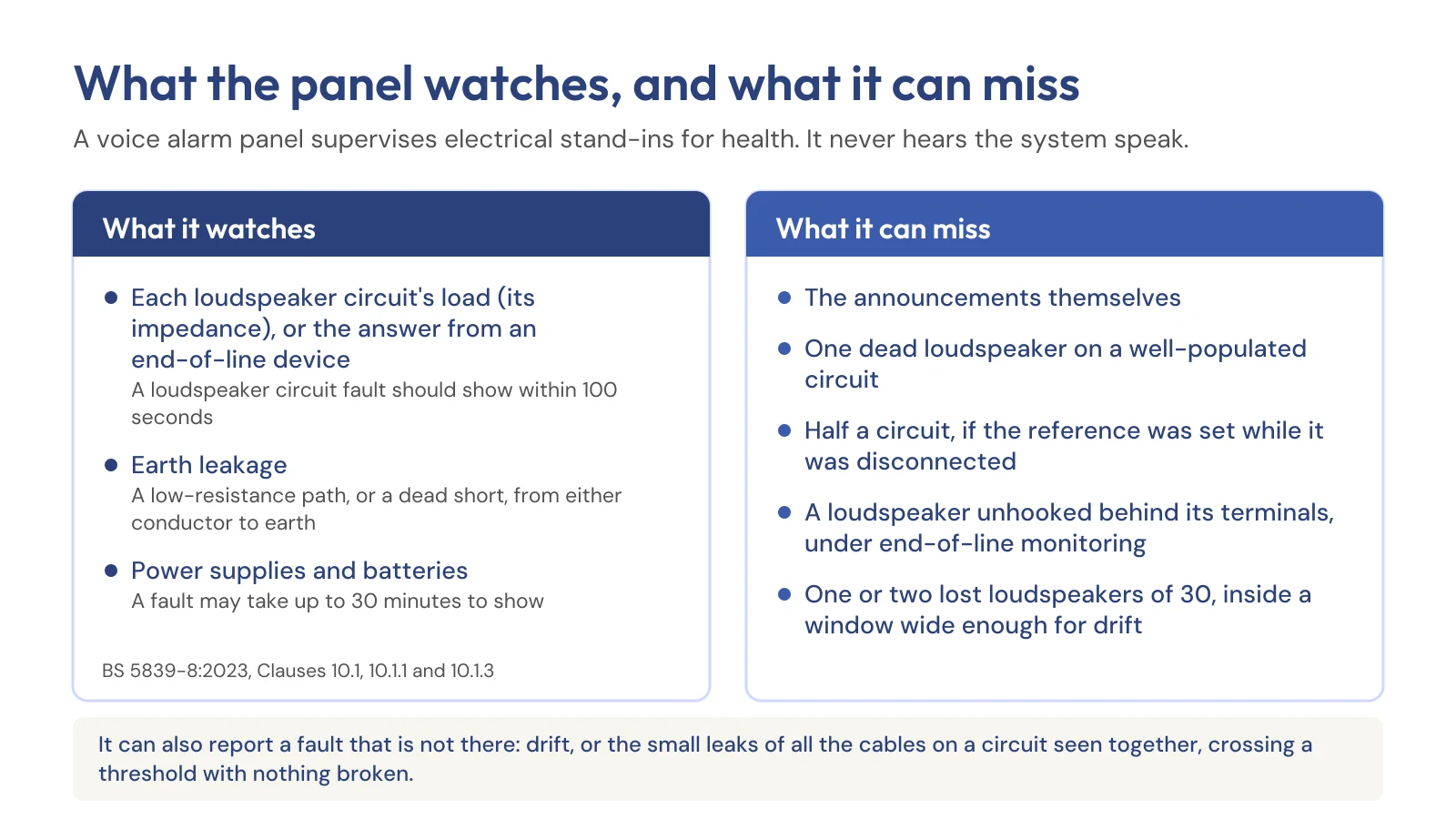
Not the announcements. A Public Address Voice Alarm (PAVA) system supervises itself electrically. The control equipment, the panel, measures stand-ins for health. On each loudspeaker circuit it watches either the load or the answer from a small end-of-line device at the far end of the cabling. The load is the electrical weight of all the circuit's loudspeakers together (its impedance). The panel also watches for earth leakage: whether either conductor has a low-resistance path, or a dead short, to earth. It watches the power supplies and the batteries (BS 5839-8:2023, Clause 10.1). A loudspeaker circuit fault should show within 100 seconds (Clause 10.1.1). A power supply or battery fault may take up to 30 minutes (Clause 10.1.3).
The watchman never hears the system speak. It infers health from electrical signatures, and an inference can be wrong in both directions.
Why would a monitor report a fault that is not there?
Because a stand-in can cross a threshold without anything failing. The code describes one case itself. The panel reports an earth fault when the wiring's resistance to earth falls below a set threshold. The code's example is 1 MΩ. At installation, each cable should test at 2 MΩ or more (Clause 33.1). But every cable leaks a little to earth, and the panel sees the leaks of all the cables on a circuit together. More leaks mean less resistance: two cables that each test at 2 MΩ already look like 1 MΩ to the panel. So a note, guidance rather than a requirement, warns of nuisance fault indications unless the combined figure sits well above the threshold. On a large system, each cable needs to test well above its 2 MΩ minimum (Clause 33.1, Note). Nothing is broken. The margin is thin.
With impedance monitoring, the panel compares each circuit with a stored reference, inside a tolerance window: a band either side that it accepts as normal. In our experience a real circuit's impedance does not sit still. It moves with the weather and with damp, and creeps as terminations and cabling age. Let that drift reach the edge of the window and the panel reports a fault on a circuit that is working.
How do you tell a crying-wolf panel from a failing system?
Read the fault log as data rather than housekeeping. A run of identical indications on the same circuit, each cleared with no component changed, has one cause. Nobody has yet been asked to find it. Find that cause and put it right, and the repeat call-outs can stop.
The code already asks for two readings of the record at every six-monthly service. The logbook should be examined to check that each recorded fault received appropriate attention (Clause 40.1 a)). Where the panel keeps an electronic fault log, it should be examined for faults that announced and then cleared (Clause 40.1 f)). So ask for a root cause per repeat indication. The answer should name a failed component or a changed measurement. "Cleared on arrival" names neither.
When does a false fault become dangerous?
When repetition has trained everyone to wait. A warning that is usually wrong teaches the people who see the panel to treat every warning as probably wrong. That is the V-22 lesson: the cost of a noisy watchman is not the noise, it is the disbelief. The one real fault arrives formatted exactly like the false ones before it.
Where does this leave your maintenance contract?
Every one of those false ones was attended. The code keeps attendance and examination apart. Every fault should be recorded in the logbook and repair arranged as soon as possible (Clause 41.2 c)); examining the record belongs to the six-monthly service. So the question is not who holds the contract. It is whether its service visit is specified to BS 5839-8, because that is where the examination is written down.
A clean record cuts the other way too. A circuit that has never once shown a fault? That proves the panel is quiet, not that the circuit is whole.
When a quiet panel is not a healthy one
In our experience impedance monitoring earns its place on circuits with many spurs, branches off the main run, where nobody can say where each line ends. But its reference can only be set to the circuit as it stands on the day.
Suppose half the loudspeakers on a circuit were disconnected that day while a ceiling was still open after works. The reference learns half a circuit as healthy. Nobody has to make a mistake for this to happen. A reference knows what is there, not what should be. Every reading afterwards matches it, and so would the annual impedance comparison (Clause 40.2 i)) if that were the only check. It is not: a thorough, compliant service checks every loudspeaker each year (Clause 40.2 c)), so the missing half should show up at the first annual visit.
Two things find it. One is comparing the reference with the installation figure, measured with every loudspeaker connected (Clause 33.4 a)). The other is the annual check that every loudspeaker works, where practicable (Clause 40.2 c)).
What the floor can't tell you
Ceiling loudspeakers are usually cut into the ceiling itself. There the annual check finds a silent area, but the floor seldom shows why it is silent. The code asks for every loudspeaker to be heard and looked at "where practicable" (Clause 40.2 c) and d)). Rarely, loudspeakers are placed above the ceiling instead. From the floor, a silent one and a missing one then can't be told apart. For new work, we recommend against mounting them that way.
In both cases, finding the cause takes a ladder, a way into the ceiling void and a torch. In our experience, a routine service is non-intrusive, and the site's permit is written that way. So the right result is a reported gap in coverage and a separate diagnostic visit.
What should a quote for finding the cause say?
The diagnostic visit is chargeable. If other remedial work is already on order, the visit can ride along with it. That lowers its cost; it does not remove it.
What the visit turns up varies. A loose wire or a loudspeaker moved out of its room is quick to put right; a new long cable run or new containment is not. Where several areas are silent, the investigation can fill a whole shift, and it can't be given a fixed price.
In our view, a maintainer should quote to progress the repairs, not to promise a fix. That means arriving with a small stock: a few spare loudspeakers, junction boxes, ceramic terminals and a length of fire-resistant cable. It means making as much progress as the shift allows. That might be fitting parts, fixing a fault, or working out what time and materials the rest will need.
We quote the visit a shift at a time, on time and materials. Your commitment is one shift; anything further is quoted, on time and materials, before it starts. Every shift ends with what was found and a price for the rest.
Can't you just widen the window?
Back on the panel, drift is the reason tolerance windows get widened, and a fair one: it stops the false call-outs. But a window wide enough to ride out a damp winter is wide enough to miss several loudspeakers going. That is not a repaired watchman. It is a blindfolded one.
Even a well-set window has a blind spot built in. Take 30 identical loudspeakers on one circuit. Losing one moves its impedance by about 3 %; losing two, about 7 %. The window has to be wider than normal drift, and in our experience that leaves one or two lost loudspeakers unseen. Yet the code wants an open circuit on any spur indicated (Clause 10.1.1 a)), even a spur feeding two of the 30.
What end-of-line monitoring watches instead
End-of-line monitoring makes a different bargain. It watches the cable, not the loudspeakers.
The code's critical signal path runs to the input terminals on, or within, each loudspeaker enclosure (Clause 3.10). A loudspeaker made to BS EN 54-24 is built to take its external conductors inside its own enclosure and terminate them there (Clause 4.4.1). So the line goes into every loudspeaker body to reach its terminals. Where the line loops on from a loudspeaker's terminals to the next loudspeaker, or to the end-of-line device, those terminals are a link in the watched cable. Remove that loudspeaker, and the cable parts. Unhook only the loudspeaker's own leads, behind its terminals, and the line stays whole. Then the panel says nothing.
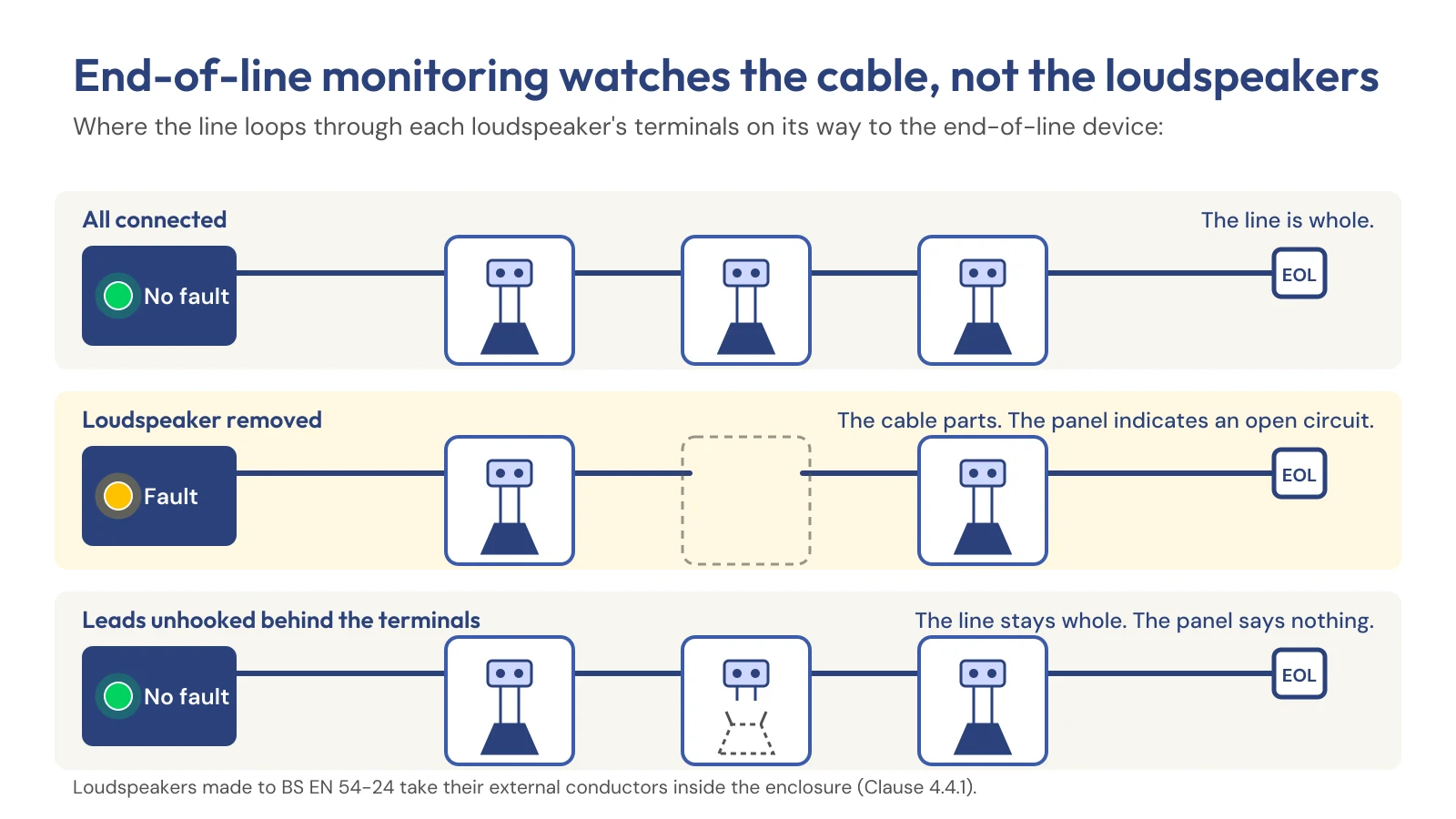
On a well-populated circuit neither method reliably tells you one loudspeaker has died. Short of a monitoring module in every loudspeaker, hearing each one is the annual check's job (Clause 40.2 c)).
Four questions for the next service report
Put these in writing to whoever maintains the system. Asked that way it is a service-report line, not a complaint.
- Which circuits produced the same indication more than three times in the last 12 months, and what was the root cause of each?
- Does each report say whether the fault sat in the system or in its monitoring?
- Which circuits are monitored by impedance, and how many loudspeakers could each lose before the panel reported it?
- Does the report list any silent areas, and what next step does it recommend for each?
A good answer names an area, a circuit, a date or a number. "All fine" names none of them.
The Osprey's evaluators did not sign off a watchman nobody could believe. They wrote that the aircraft was effective but not suitable for service, that the diagnostic shortfalls had to be corrected, and that uncorrected they would be an unacceptable burden on the fleet. A building full of people deserves the same standard for the thing watching its voice alarm.
Next in this series: a healthy battery made to look faulty, not by the panel but by an undersized cable.
Where this comes from
Every requirement this page relies on, with its clause, our explanation in our own words, and the official source to check it against. We paraphrase the standards; we do not reproduce their text.
| What the article says | Source | In our words | Official source |
|---|---|---|---|
| V-22 operational evaluation, November 1999 to July 2000, 804 flight hours, 522 sorties; detection and identification rates exceeded requirements; false alarm rate so high the automated diagnostics were of little or no value; effective but not suitable; shortfalls to be corrected, an unacceptable burden on the fleet until they are | Director, Operational Test and Evaluation, FY2000 Annual Report, V-22 Osprey section | Not applicable | DOT&E FY2000 Annual Report, V-22 (GlobalSecurity reproduction) |
| What the panel should indicate: loudspeaker circuit faults including earth faults, power supplies and batteries | BS 5839-8:2023, Clause 10.1 | Our explanation | BSI: BS 5839-8 |
| A loudspeaker circuit fault should be indicated within 100 seconds | Clause 10.1.1 | Our explanation | BSI: BS 5839-8 |
| An open circuit on any loudspeaker circuit, including any spur, should be indicated (the clause names no monitoring method) | Clause 10.1.1 a) | Our explanation | BSI: BS 5839-8 |
| Power supply and battery faults indicated within 15 to 30 minutes (standby supply 15, mains, charger and low battery voltage 30) | Clause 10.1.3 | Our explanation | BSI: BS 5839-8 |
| The critical signal path is defined as ending at the input terminals on, or within, each loudspeaker enclosure | Clause 3.10 (a definition) | Our explanation | BSI: BS 5839-8 |
| At installation, each cable's insulation resistance between each conductor and earth should be at least 2 MΩ (at 500 V DC, for mains-rated cable) | Clause 33.1 | Our explanation | BSI: BS 5839-8 |
| Two cables on the same circuit that each test at 2 MΩ to earth combine to 1 MΩ as the panel sees them | Arithmetic: resistances to earth act in parallel, 1 / (1/2 + 1/2) = 1 MΩ. Panels differ in what they combine: some sense earth faults per output, some across the system (BS EN 54-16 Clause 8.2.3 b) asks for "an indication at least common to any earth fault of less than 50 kΩ"); "on a circuit" is true of both. Both conductors of a cable leak, so the real combined figure can be lower still | Not applicable | BSI: BS EN 54-16 |
| Nuisance earth-fault indications unless the wiring's combined resistance to earth is well above the panel's earth-fault threshold (example 1 MΩ); on a large system each cable needs to be well above its 2 MΩ minimum | Clause 33.1, Note (informative) | Our explanation | BSI: BS 5839-8 |
| Installation measurement of every circuit's 1 kHz impedance, after connection of all loudspeakers | Clause 33.4 a) | Our explanation | BSI: BS 5839-8 |
| Six-monthly examination of the logbook for appropriate attention to recorded faults | Clause 40.1 a) | Our explanation | BSI: BS 5839-8 |
| Six-monthly examination of the electronic fault log for faults that announced and cleared | Clause 40.1 f) | Our explanation | BSI: BS 5839-8 |
| Annual check that every loudspeaker works, where practicable | Clause 40.2 c) | Our explanation | BSI: BS 5839-8 |
| Every loudspeaker checked for correct operation, and visually examined for damage, where practicable | Clause 40.2 c) and d) (letters lost in the PDF's text layer; by position after a) and b)) | Our explanation | BSI: BS 5839-8 |
| Ceiling loudspeakers are usually cut into the ceiling, where the floor seldom shows why a silent one is silent; rarely they are placed above it, where a silent and a missing loudspeaker sound the same from the floor, and ProAudium recommends against that mounting for new work; a non-intrusive service reports the gap and a diagnostic visit finds the cause | ProAudium field experience and recommendation (N. Williams, 18-19 October 2026) | Not applicable | Not applicable |
| The diagnostic visit is quoted a shift at a time on time and materials, to progress the repairs, not to promise a fix; your commitment is one shift, and anything further is quoted on time and materials before it starts | ProAudium commercial practice (N. Williams, 18-19 October 2026) | Not applicable | Not applicable |
| Every shift ends with what was found and a price for the rest | ProAudium commercial practice (N. Williams, 19 October 2026) | Not applicable | Not applicable |
| Annual measurement of every loudspeaker circuit's impedance, compared with the previous year's | Clause 40.2 i) | Our explanation | BSI: BS 5839-8 |
| Every fault recorded in the logbook and repair arranged as soon as possible | Clause 41.2 c) | Our explanation | BSI: BS 5839-8 |
| Impedance drifts with weather and damp, and creeps as terminations and cabling age | ProAudium field experience (N. Williams, 17 October 2026); no standard states it | Not applicable | Not applicable |
| Impedance monitoring earns its place on circuits with many spurs and no known line ends | ProAudium field experience (N. Williams, 17 October 2026) | Not applicable | Not applicable |
| A reference can only be set to the circuit as it stands; a half-disconnected circuit is learned as healthy | ProAudium field experience (N. Williams, 17 October 2026); illustrated as a pattern, not a cited case | Not applicable | Not applicable |
| Losing one of 30 identical loudspeakers moves the circuit impedance by about 3 %, two by about 7 % | Arithmetic: 30/29 = 1.034, 30/28 = 1.071, for ideal parallel loads; cable resistance, and cable capacitance at the monitoring frequency, make the real shift smaller | Not applicable | Not applicable |
| A window wider than normal drift leaves one or two lost loudspeakers of 30 unseen | ProAudium field experience (N. Williams, 17 October 2026) | Not applicable | Not applicable |
| The line enters every loudspeaker enclosure to reach its terminals; looped on from those terminals, removing a loudspeaker parts the monitored cable, while unhooking only its own leads leaves the line whole | BS 5839-8:2023 Clause 3.10 (critical signal path to the input terminals on, or within, each enclosure) with BS EN 54-24:2008 Clause 4.4.1 ("space within its enclosure for external conductors to be brought in and terminated"); loop-in, loop-out wiring is the installation practice, since neither standard forbids spurs (BS 5839-8 Clause 10.1.1 a), Clause 31 commentary) | Our explanation | BSI: BS 5839-8; BSI: BS EN 54-24 |
| On a well-populated circuit neither method reliably detects one loudspeaker that has died; some systems offer a monitoring module per loudspeaker | ProAudium analysis (`loudspeaker-circuit-monitoring` skill, audited 12 October 2026) | Not applicable | Not applicable |