
Battery series · Part 9 of 10
Voice alarm battery sizing, where the loudspeakers cut battery demand and the standby current pushes it higher
Real figures make a first estimate right, not always smaller. Two inputs decide which way it moves, and the standard's own guidance says which way one of them leans.
Reviewed on

Apollo 11's flight plan gave it more than one chance to correct course on the way to the Moon. The first was cancelled as unnecessary. The second was an engine burn of 2.91 seconds that changed the spacecraft's velocity by 6.4 m/s.
The launch was sound, and the planned corrections kept it on course. A first battery calculation for a voice alarm works the same way. Aim with the figures you have. Correct as the real ones come in.
What does a first estimate guess?
Level 1 of the ProAudium Battery Calculator asks two questions: the total loudspeaker load, and the number of loudspeaker zones. It assumes the rest, including Class D amplifiers and a 24 V supply, and lists every assumption beside the answer.
Its standby current is an estimate from the zone count: 0.25 A, plus 0.03 A per zone, plus 0.05 A per fire microphone, with one microphone per five zones. The calculator says plainly that this is its own model, not yet checked against a survey of real systems.
We took part 6's system: eight zones and 1200 W. Suppose that 1200 W is the amplifiers' rating, entered as the load because it is the figure to hand before anyone adds up the loudspeakers. Level 1 gives 27.71 Ah, and the next size up is 38 Ah.
"Isn't more battery the safe side?"
A battery sized from real figures still follows the code's method in full. The calculation already multiplies by 1.25, to allow for temperature variation and battery ageing (BS 5839-8:2023, Annex C, C.1.2). Real figures take out guesswork, not that margin. And sometimes they put battery in.
Why the two big guesses pull opposite ways
Two inputs move the answer most: the loudspeaker load and the standby current. Level 1 estimates the standby current itself. The load is only as good as the figure typed in, and the amplifiers' rating is an easy one to reach for.
The load first. The code's load is the sum of the power each loudspeaker needs (Annex C, C.2.4 c), plus any spare capacity the specification calls for (C.2.4, Note 2). A note adds that the loudspeaker power is often significantly less than the amplifier's rated output. The calculator's own tip says to add up the tap setting of every loudspeaker, and that this is usually less than the amplifiers' rated output. A first run that used the amplifier rating has put battery in for power no loudspeaker draws.
Then the standby current. In part 6, installed eight-zone panels rarely drew as little as Level 1's 0.59 A, once network equipment, monitoring and every amplifier channel were counted. And the standby current is carried for 48 times as long as the alarm current (Clause 25.3.5 a), so a small error there moves the answer a long way.
One change at a time
Here is the same system at Level 2, changing one figure at a time. Level 2's first answer is a little higher than Level 1's: until you choose a battery, it sizes with a conservative default and says so. The loudspeaker loads and standby currents below are chosen for the example.
| What changed | Minimum capacity | Next size up |
|---|---|---|
| Level 1, the amplifiers' 1200 W as the load | 27.71 Ah | 38 Ah |
| Level 2, the same figures | 28.76 Ah | 38 Ah |
| Loudspeakers tapped to 600 W in all | 23.65 Ah | 24 Ah |
| Standby current measured at 1.0 A | 41.65 Ah | 65 Ah |
| Both: 600 W and 1.0 A | 36.54 Ah | 38 Ah |
| Both: 600 W and 1.7 A | 58.55 Ah | 65 Ah |
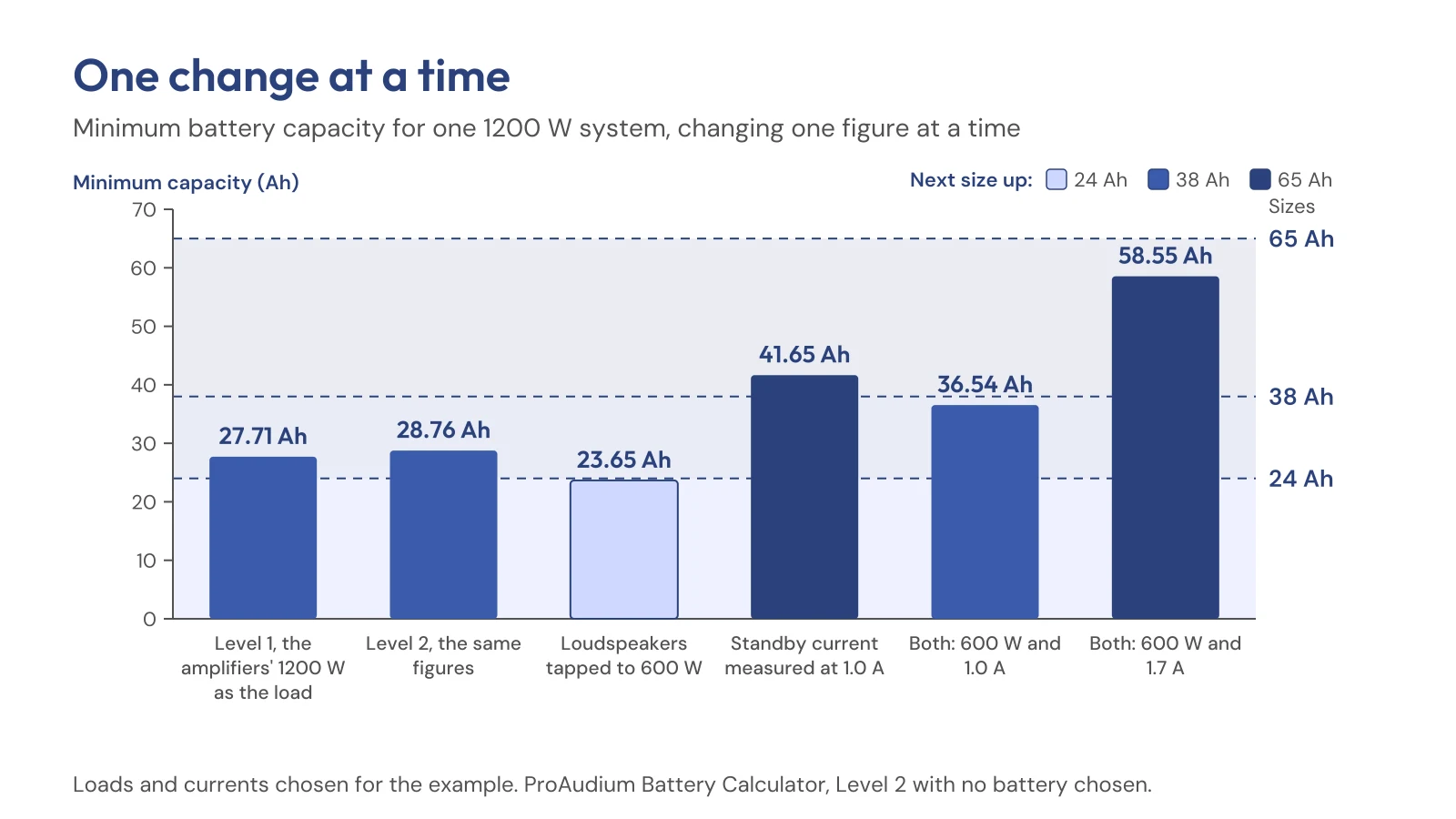
The tapped load took a size off, 38 Ah down to 24 Ah. The measured standby current put one on, 38 Ah up to 65 Ah. With both, the answer is 38 Ah again. It is the same size as the first guess, but now each figure behind it can be checked. At 1.7 A, one of the higher standby currents part 6 ran, it is 65 Ah even on the smaller load.
When refining goes the wrong way
Real figures help only if they are the right figures. The calculator names three ways the standby figure goes wrong, all on the datasheet. One is reading the sleeping current when the system will sit supervised; where both are printed, the supervised figure can be several times the sleeping one. Another is mixing up per channel and per unit, which is a factor of four on a four-channel amplifier. The third is reading a maximum or a fuse rating as a consumption.
Taking one channel's current as the whole amplifier's undersizes the battery. That is the one to catch.
Amplifier efficiency matters far less. Get it wrong within one class of amplifier and the answer moves by a few per cent.
What it changes: the battery you buy, and the recharge
The size you buy, house and replace, at every replacement for the life of the system. There is one knock-on. A battery larger than the system was designed around can take too long to recharge, and the code's guidance warns of it (Clause 25.3.4, Note). Levels 2 and 3 of the calculator run that check when you enter the charger's output current.
"What does it cost me to leave the first estimate alone?"
In the example, either way round: a system that needs 24 Ah carrying 38 Ah, or one that needs 65 Ah carrying 38 Ah. Each result lists every assumption beside it, so the next person can check where each figure came from.
In short
- A first estimate takes the load as typed in and estimates the standby current, and the two lean opposite ways.
- The code's load is the loudspeakers' sum plus any specified spare capacity, often well under the amplifiers' rating, so the tap settings usually take battery off.
- A measured standby current usually puts battery back.
- Right, not smaller, is the promise. In the example, both changes together land on the same 38 Ah, for reasons that can be checked.
Apollo 11's flight plan expected to correct course on the way. Size a voice alarm battery the same way: aim with the figures you have, then correct as the real ones come in.
Next step. If a battery figure is on your desk, two questions settle most of it. Was the load taken from the loudspeakers' tap settings or the amplifiers' rating? And where did the standby current come from: a datasheet, a measurement, or an estimate? To see the effect, open the rows above and put in your own system's figures at Level 2 of the ProAudium Battery Calculator. No email, no form. If you would like the calculation checked against what is installed, contactus@proaudium.com or 01273 034630.
Where this comes from
Every requirement this page relies on, with its clause, our explanation in our own words, and the official source to check it against. We paraphrase the standards; we do not reproduce their text.
| What the article says | Source | In our words | Official source |
|---|---|---|---|
| The 1.25 multiplier allows for some ambient temperature variation and battery ageing | BS 5839-8:2023, Annex C, C.1.2 | Our explanation | BSI: BS 5839-8 |
| The load in the calculation is the sum of the required maximum output powers to all loudspeakers | Annex C, C.2.4 c) | Our explanation | BSI: BS 5839-8 |
| Spare capacity the specification calls for increases the load (a note: guidance) | Annex C, C.2.4, Note 2 | Our explanation | BSI: BS 5839-8 |
| The loudspeaker power required is often significantly less than the amplifier's rated output (a note: guidance) | Annex C, C.2.4, Note 1 | Our explanation | BSI: BS 5839-8 |
| 24 h standby, then at least 30 min of evacuation messages in all alarm zones | Clause 25.3.5 a) | Our explanation | BSI: BS 5839-8 |
| Connecting a larger battery than designed can give unacceptably long recharge times (a note: guidance) | Clause 25.3.4, Note | Our explanation | BSI: BS 5839-8 |
| Installed eight-zone panels rarely draw as little as 0.59 A in standby | Published part 6 | A 1200 W voice alarm's battery is sized by its quietest 24 hours | Not applicable |
| Apollo 11's first planned course correction was cancelled as unnecessary; the second was a 2.91 s burn changing speed by 20.9 ft/s (6.4 m/s) | Apollo 11 Flight Journal, Day 2, part 1: Midcourse Correction (eds W. David Woods, Kenneth D. MacTaggart and Frank O'Brien) | Not applicable | Apollo Flight Journal |
| Level 1's questions, assumptions and quiescent model; Level 2's conservative default; the load tip; the three datasheet errors; efficiency moves the answer a few per cent | ProAudium Battery Calculator, field tips and help copy | Battery Calculator | Not applicable |
| All capacities in the table | ProAudium Battery Calculator, Levels 1 and 2 (no battery chosen), run 20 October 2026 with the calculator's own engine; each row links its inputs | Battery Calculator | Not applicable |