
Battery series · Part 10 of 10
Voice alarm batteries kept at 35 °C: 60 % of the life you paid for [and it's hotter around the batteries than you might think]
The room can be cool while the batteries are not. Here is the one reading to ask for at the next service.
Reviewed on
Nobody argues with the date on a carton of milk, and nobody argues that leaving it on the worktop all afternoon takes days off that date. The fridge does not stop milk turning. It slows it down.
A voice alarm battery has a date too: the service life it was bought for. Heat takes years off it just as quietly, and nothing on the label changes.
A cool room does not mean cool batteries
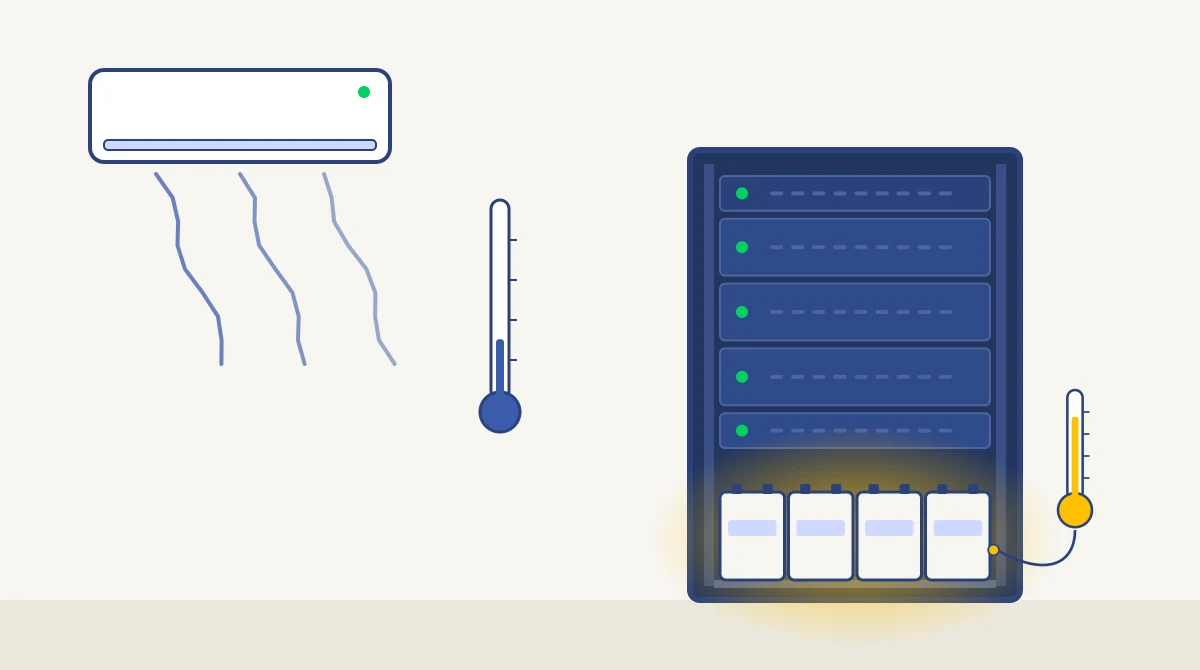
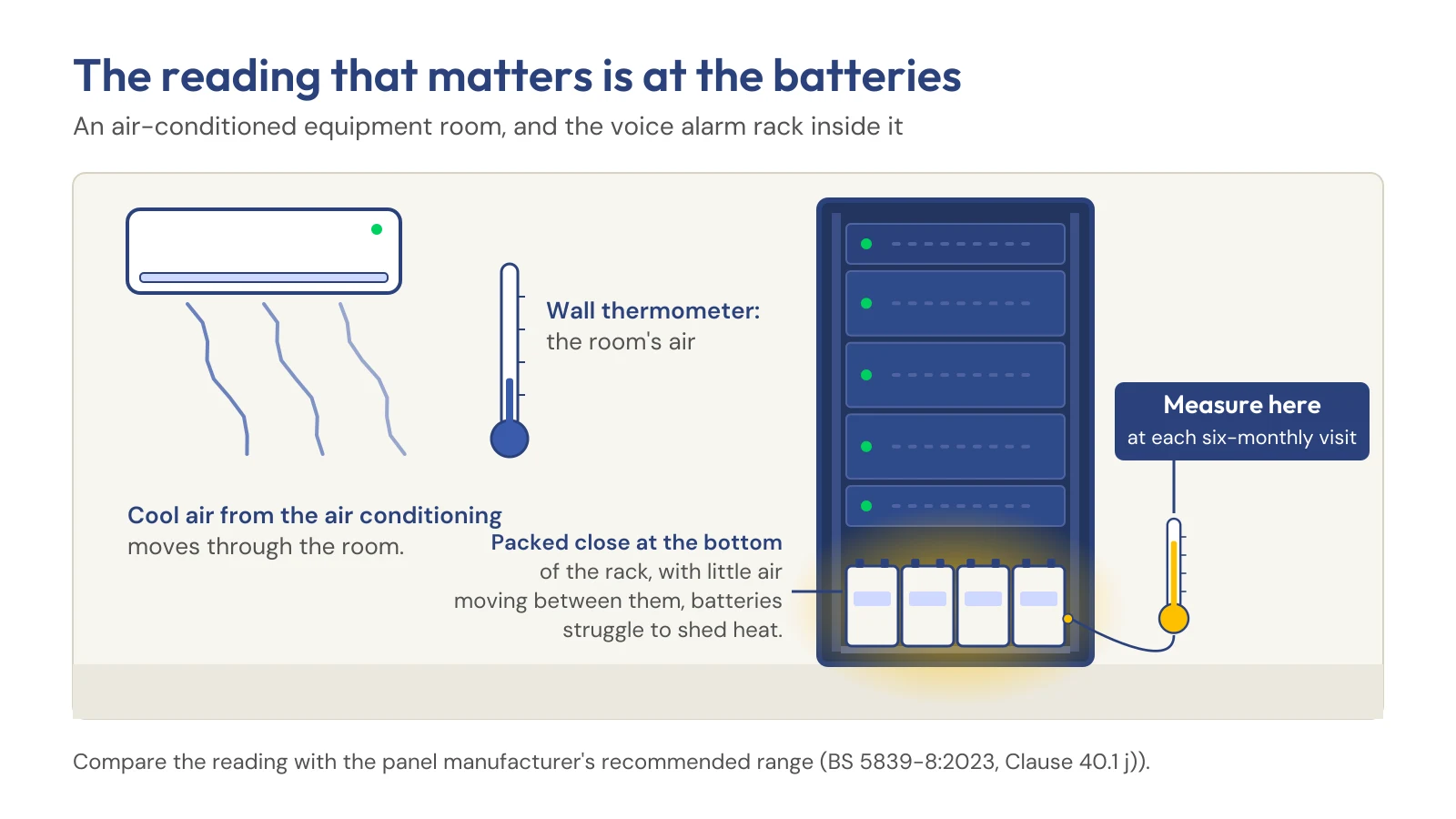
Most of the equipment rooms we work in are air-conditioned. That is where a Public Address Voice Alarm (PAVA) system keeps its racks and standby batteries. The thermometer on the wall shows a comfortable reading, and nobody standing there feels warm.
But the batteries are not where you stand. They usually sit at the bottom of the rack, packed close together. Heat rises, so that ought to be the cool end. In our experience it often is not. Packed that close, with little air moving between them, the batteries struggle to shed heat.
The temperature that matters is the one at the batteries.
Why does heat age a battery that is doing nothing?
A standby battery spends almost its whole life on charge, waiting. Waiting is not resting. The life a battery maker quotes assumes 20 °C to 25 °C around it. The code's own note says high ambient temperature cuts that life dramatically (BS 5839-8:2023, Annex C, C.1.2, Note 1).
How much life does the heat take?
The same note puts a number on it. Its example is a valve-regulated lead acid battery. That is the sealed kind used for voice alarm standby. Kept at a continuous 35 °C, it can expect only 60 % of the life it would have at 20 °C (Annex C, C.1.2, Note 1). It is guidance, not a requirement. A battery specified for five years gets three.
A battery maker's rule of thumb is harsher. Power-Sonic estimates that life halves for each 10 °C above normal room temperature (Power-Sonic, Technical Manual: Sealed Lead-Acid Batteries, Temperature Effects). The two sources disagree on how much. They agree on the direction.
When does the loss show up?
Not on the day, and not on the panel. Power-Sonic's manual treats a standby battery as at the end of its life once it holds only 60 % of its original capacity (Battery Life, Standby Use). That is a different 60 % from the code's. One is a share of capacity, the other a share of life.
So a battery at the end of its life is not flat. It sits at its normal charging voltage and usually looks fine. The loss is capacity, and only a capacity test shows it.
The panel will not flag it either. The code's list of power faults covers the mains, the standby supply, the charger and low battery voltage (Clause 10.1.3). Temperature is not on it.
"We replace them every four years and have never had a failure"
No failure and full capacity are different things. The code's sizing formula does add 25 % for some temperature variation and ageing (Annex C, C.1.2). That margin is for some variation, not for years in warm air.
At a continuous 35 °C, a five-year battery can expect three. On a four-year cycle, it spends the last year past the end of its life. That is how heat shortchanges a battery: quietly. A replacement interval taken from the label assumes the label's temperature.
What if the room stops being cool?
Keeping the batteries near the label's temperature depends on the air conditioning. Summer against winter rarely matters in an air-conditioned equipment room. What gets overlooked is whether the air conditioning is still working, and still maintained. If the room runs warm, the batteries run warmer.
Air conditioning is a different trade from voice alarm, usually on a different contract. Its upkeep can fall between the two. That is nobody's mistake; it is what happens when two trades share a room. The air conditioning should have a named owner and a service record, the same as the voice alarm.
Where should the thermometer go?
At the batteries, not on the wall. The code already lists this check for the six-monthly service. The ambient temperature near the batteries should be checked against the panel manufacturer's recommendations. Where appropriate, new batteries should be fitted or other remedies recommended (Clause 40.1 j)). It is one line on the visit sheet, and easy to leave off a report, because a warm battery never raises a fault.
Ask whoever maintains the system to add three things to the next service report:
- The temperature at the batteries, at each six-monthly visit.
- How it compares with the panel manufacturer's recommended range.
- If it runs high, a note saying so, because warm batteries wear out faster.
Reporting the reading, with a recommendation, is the maintainer's part. Improving the ventilation at the rack is a job for whoever built it: often the voice alarm equipment manufacturer, sometimes the installer. The code places ventilation with the installation (Clause 31.2 c)).
The choice is then yours, or the building owner's: better ventilation from the rack's builder, or closer checks, earlier replacement, or both. The code's note says a battery that cannot be kept near the label's temperature will need replacing more often (Annex C, C.1.2, Note 1).
None of this needs a new contractor or a dispute. A reading that creeps up between visits is also worth passing to whoever maintains the air conditioning.
At a continuous 35 °C the code's note puts the cost at two years in every five. The check is already part of the six-monthly visit.
The date on a carton assumes a working fridge. The life on a battery's label assumes cool air around it. Check the air, and you will know whether you are getting the life you paid for.
Where this comes from
Every requirement this page relies on, with its clause, our explanation in our own words, and the official source to check it against. We paraphrase the standards; we do not reproduce their text.
| What the article says | Source | In our words | Official source |
|---|---|---|---|
| The service life a battery maker quotes assumes 20 °C to 25 °C; high ambient temperature reduces it dramatically; if the battery cannot be kept there it will need replacing more often | BS 5839-8:2023, Annex C, C.1.2, Note 1 (informative) | Our explanation | BSI: BS 5839-8 |
| A valve-regulated lead acid battery at a continuous 35 °C has an expected life of only 60 % of its specified life at 20 °C | BS 5839-8:2023, Annex C, C.1.2, Note 1 (informative) | Our explanation | BSI: BS 5839-8 |
| The sizing formula's multiplying factor of 1.25 allows for some ambient temperature variation and battery ageing | BS 5839-8:2023, Annex C, C.1.2 | Our explanation | BSI: BS 5839-8 |
| The power faults the panel should indicate: main supply, standby supply, battery charger, battery voltage below the BS EN 54-4 threshold; temperature is not among them | BS 5839-8:2023, Clause 10.1.3 | Our explanation | BSI: BS 5839-8 |
| Cooling or ventilation that can keep the equipment within its rated temperature range should be provided as part of the installation | BS 5839-8:2023, Clause 31.2 c) | Our explanation | BSI: BS 5839-8 |
| At intervals not exceeding six months, the ambient temperature in the vicinity of the batteries should be checked against the VACIE manufacturer's recommendations, and replacement batteries installed or other remedial measures recommended if appropriate | BS 5839-8:2023, Clause 40.1 j) | Our explanation | BSI: BS 5839-8 |
| It is estimated that battery life halves for each 10 °C above normal room temperature | Power-Sonic, *Technical Manual: Sealed Lead-Acid Batteries*, Temperature Effects | Not applicable | Power-Sonic Technical Manual (Battery Junction copy) |
| At 20 °C to 25 °C on float, Power-Sonic batteries should last four to five years before capacity drops to 60 % of its original rating (Power-Sonic's end-of-life definition) | Power-Sonic Technical Manual, Battery Life, Standby Use, with Figures 10 and 11 | Not applicable | Power-Sonic Technical Manual (Battery Junction copy) |
| A battery specified for five years at 20 °C gets three at a continuous 35 °C; on a four-year cycle it spends the fourth year past the end of its life; the cost is two years in every five | Arithmetic on the code's note: 5 × 0.60 = 3.0; 4 − 3 = 1; 5 − 3 = 2 | Not applicable | Not applicable |
| Most voice alarm equipment rooms are air-conditioned; batteries usually sit together at the bottom of the rack, where they struggle to shed heat; seasons rarely matter, and whether the air conditioning is working and maintained is what gets overlooked | ProAudium field experience (N. Williams, 18 October 2026) | Not applicable | Not applicable |
| Improving the ventilation at the rack is a job for whoever built it, often the voice alarm equipment manufacturer and sometimes the installer; poor ventilation makes the batteries deteriorate faster, so the maintainer's part is to report the temperature; the owner then chooses better ventilation, or closer checks, earlier replacement or both | ProAudium field experience (N. Williams, 23 October 2026) | Not applicable | Not applicable |