
Maintenance · Guide
How much PAVA service stock to hold, and why it buys years of system life
The usual reasons for holding spares are wrong and deserve to be rejected. The real one is years of system life, and British Standard BS 5839-8:2023 already recommends holding spares on the premises. It just leaves the list to you.
Reviewed on

In 1995 I was in Prague with my Czech girlfriend, her brother and their friends. They spoke little English, I spoke almost no Czech, and we had a great evening, which I put down to her brother's toast with a liquorice-tasting green drink. Absinthe. Not to my taste, but it knocked the language barrier flat.
Back home, friends explained why: a Czech invention, and an addictive hallucinogen. Every one of those facts is a myth. Absinthe was banned, though not in the 1990s and never in the Czech Republic or the UK. It has no hallucinogenic effect. It was developed in Switzerland. A better story won, and it left me with no answer to why the evening had worked at all.
Myths grow everywhere, and one of the places they have taken firm root is Public Address Voice Alarm (PAVA) service stock.
The case against holding spares is sound, and it answers the wrong question
Emergencies are unpredictable, so a voice alarm system has to be available and reliable at all times. Spares look like an obvious answer, and there is a respectable case against them.
It runs like this. A system designed and installed to BS 5839-8:2023 has end-to-end fault monitoring, with faults indicated within 100 s (Clause 10.1.1), and a call-out agreement under which a technician normally attends within 8 h on a 24 h basis (Clause 41.2 a). Where a risk assessment calls for it, standby amplification takes over automatically (Clause 15.1). So the system reports its own failure, somebody attends the same day, and it is fixed. Why hold stock for a system that already handles its own faults?
It sounds complete. It describes the hours after a failure, and says nothing about the weeks. Clause 41.2 sets a clock on attendance and asks for repair "as soon as possible" (41.2 c), with no time on the part. And one clause later the standard says something the case against spares never mentions: spare parts agreed between the user and the maintenance organisation should be held within the premises (Clause 42 g). The code expects spares on site. It does not say which.
The phrase "service stock" carries three assumptions, and all three are false
The phrase does the damage. The words suggest maintenance spares, and three things follow from that without anyone saying them:
- service stock reduces maintenance costs
- service stock can be left on a shelf until it is needed
- service stock improves emergency system performance.
You will have seen through all three, because all three are false. Stock costs money to maintain, it deteriorates on a shelf, and it does nothing whatever for the performance of a working system.
Rejecting it on those grounds is correct. The cost is that the real case goes out with it, and the real case is worth far more.
Service stock is how you avoid replacing the whole system
Service stock is equipment that lets you extend the life of the system by years.
Replacing a complete system costs far more than the kit. It can mean closing the building, or posting fire wardens throughout it for weeks, and your insurer will want to know how the building is covered in the meantime. A waking watch alone in a multi-storey building runs to thousands of pounds a week. The replacement equipment is perhaps half of what the job really costs once the mitigation is counted.
All of that can be avoided, or at least reduced, by holding spares.
Many voice alarm manufacturers are small companies, and Clause 41.2 makes no allowance for it
Most of them are small companies, and the large ones build their UK ranges in small batches too. Having worked for two of them, I can say none of this is a failing; it is how a specialist manufacturer has to operate, and it has four consequences for a building that depends on the kit:
- they keep little stock
- they build in small batches, so equipment can be weeks away
- they use components available from only one or two suppliers, so a discontinued or out-of-stock part can delay a product indefinitely
- their latest batches can be incompatible with older versions, and discontinued components are often the reason.
On top of that, manufacturers are bought and sold, and a change of owner can change what is supplied and for how long. These things happen with very little warning.
If you have never waited weeks for a part, that is the normal experience, and it says nothing about the next failure. The lead time only shows itself the first time a part is not on the shelf.
Now put that beside the clauses. Attendance within 8 h is the easy half, and most maintainers meet it. A compatible part, carrying a compatible software and firmware version, is the other half, and the standard sets no time on it. That is why Clause 42 g) puts spares on the premises rather than in a supplier's forecast.
Holding your own stock is how you keep a voice alarm system out of that gap. Which raises the question of what to hold, because you are balancing that risk against the cost of buying and maintaining the stock.
Clause 42 g) leaves the list to you, so rate each item on three questions
BS 5839-8 recommends that the spares be "agreed between the user and the organization responsible for the maintenance" (Clause 42 g). It does not say which parts or how many, and nothing in the servicing clauses adds a method. That gap is the whole reason the decision gets made on the three assumptions above. The method below is how to reach the agreement the clause asks for.
Clause 42 g) also gives you the line to use with whoever maintains the system: the standard asks us to agree a spares list, so here is the one we would like to agree. Nobody is being accused of anything, and the same list, with the lead times beside it, is the justification finance will ask for.
Start by listing every item in the system. Then rate each one against three questions: 1 to 5 on lead time and on quantity, 1 to 3 on criticality.
| Question | 1 | 2 | 3 | 4 | 5 |
|---|---|---|---|---|---|
| Longest time to get a replacement unit (days) | 1 | 2 to 4 | 5 to 14 | 15 to 30 | Over 30 |
| How critical is this unit to voice alarm operation? | Low | Medium | High | ||
| How many are installed in the system? | 16 or more | 8 to 15 | 4 to 7 | 2 to 3 | 1 |
Add the three scores together. The rating runs from 3 (low importance) to 13 (essential).
Count compatibility checking in time to supply. Every voice alarm system depends on software and firmware that manufacturers update with fixes and features, so the spare has to be checked for compatibility. If the spare and the installed system differ, either the system is updated to match the spare or, where that is impossible, the spare is downgraded. Either way the part must then be tested in the system.
Now convert the rating into a quantity. The conversion is ProAudium's working rule, not a clause; it is set so that anything that matters and is slow to obtain is held in depth.
| Rating | Stock as a percentage of in-service units |
|---|---|
| 3 | Nil |
| 4 and 5 | 5 % |
| 6 to 8 | 10 % |
| 9 to 11 | 35 % |
| 12 | 70 % |
| 13 | 100 % |
Round to the nearest whole unit, halves upward, and never below one for any item scoring above nil. An item rated 8 in a system of 12 units gives 10 % of 12, which is 1.2, rounded to one unit.
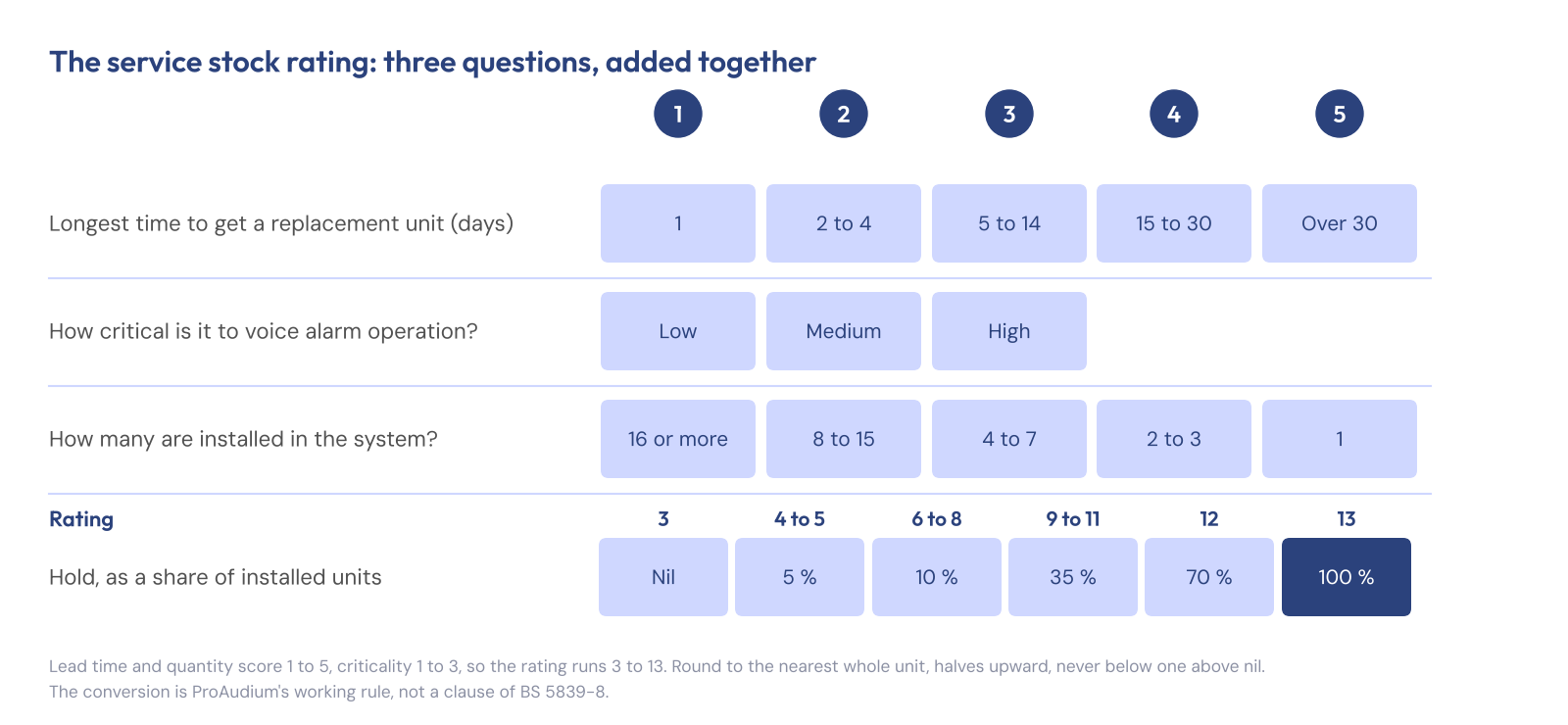
One objection arrives at this point: the maintainer already has access to spares, so why should the building hold them? The standard answers it in two places. The commentary to Clause 40 expects the servicing organisation to have access to spares, which covers the service visit. Clause 42 g) separately asks for agreed spares to be held within the premises, which covers the failure that happens between visits, when the part the maintainer has access to is in a warehouse and the one you need is on your shelf. The two are not alternatives.
A day's lead time keeps 250 loudspeakers at 5 %
A venue has 250 ceiling loudspeakers of a current model. Replacements arrive within a day, so lead time scores 1. One silent loudspeaker does not disable the system, so criticality is medium and scores 2. There are 16 or more installed, which scores 1.
1 + 2 + 1 gives a rating of 4, so 5 % service stock; 5 % of 250 is 12.5, rounded to 13 loudspeakers.
A standby amplifier takes one step off criticality, and sometimes none off the holding
A venue has six 250 W amplifiers. Replacements take two to four days, scoring 2. An amplifier is of high criticality, scoring 3, but where the system has a standby amplifier that automatically replaces a failed unit (Clause 15.1 a), criticality drops one step to medium, scoring 2. Apply that reduction only where the ratio is 10 or fewer in-service units to each standby; manufacturers mostly build in one standby for every four to eight channels, so the cap is the outer limit rather than the usual case. There are six installed, which scores 3.
2 + 2 + 3 gives a rating of 7, so 10 % service stock; 10 % of 6 is 0.6, rounded to one amplifier.
Here the step makes no difference to the holding; it would if the lead time were five to fourteen days, where the rating drops from 9 to 8 and the holding from two amplifiers to one. And a standby amplifier is not a spare on a shelf: the standard requires every standby to be kept powered up and continuously monitored (Clause 15.2). A boxed amplifier in the store is service stock, not a standby.
Stock nobody has looked at for five years is storage, not stock
That saving holds only while the stock is usable, and four things keep it that way.
Storage has to be clean, secure and quick to reach
Crushing, rough handling, damp, dust and warmth all shorten a part's life. Stock that cannot be used is the worst outcome: the money and the space are wasted and the gap is still there. If the central equipment sits somewhere decent, that is probably the right home for the spares. Otherwise anywhere clean, dry and cool will do, so long as you can get at it quickly.
Inspect and test the stock at least once a year
Unpack and examine every part. Where a spare controller or processor card carries a clock battery, check its date and replace it at the maker's interval, not only when it fails. If the installed system has had firmware or software updates, update the spares to match.
Performance checks tell you how much life the system has left
Powering the equipment up and running it in life-like scenarios is awkward, slow and expensive. There is a cheaper way that does the same job for the central equipment: every two years, at the annual service, have the maintainer swap the spare amplifiers, power supplies, controllers and call stations into service and take the in-service units out. A swapped unit is re-assigned in the configuration, tested as Clause 41.3 c) lists for the parts affected, and recorded in the logbook; a like-for-like swap is repair rather than modification, so a modification certificate is not normally needed, but the test record is. You then know both sets work, and the units you removed can be cleaned and serviced. Loudspeaker spares are inspected and bench-tested; swapping them in the ceiling is labour without benefit. Set against replacing an entire system early because the spares had quietly rotted, all of this is inexpensive.
A rating review tells you when the system dies
Stock gets used, and support is withdrawn. Re-rating the system and the stock lets you plan replacement with time in hand, and time is what lets you choose carefully, save money and improve performance. It also opens the alternative to wholesale replacement: upgrading slowly, spreading cost across several budget years, and never being without a working voice alarm while you do it. Re-rate at least every two years, and no less than every three.
Six things to take from this
- Clause 41.2 sets a clock on attendance, not on the part. Clause 42 g) says agreed spares should be held on the premises, and leaves the list to the user and the maintainer.
- Compatible service stock closes that gap and extends system life, which can save tens of thousands of pounds.
- Those savings have nothing to do with the three assumptions the phrase carries, and rejecting those assumptions is correct.
- Rate every item on lead time, criticality and quantity; convert the rating to a holding with the second table.
- Budget for maintaining the stock every year, or it becomes wasted money and wasted space.
- Safeguard it through all four parts of the process, not storage alone.
It was the alcohol that sealed the friendship, and the argument was never about it
Not the hallucinogen, because there was never a hallucinogen. It was partly that I was dating their friend's sister, and mostly that the alcohol content was far higher than anything I had drunk before or since, which did for everyone's inhibitions quickly.
The thing everyone argued about was never the active ingredient. It is the same with service stock: the claims people spend their time rejecting were never the reason to hold it, and the real reason was behind them all along.
So, to absinthe friends.
Next step: take ten minutes and list the items in your system that only exist once. That short list is where your exposure lives, and you do not need a rating table to write it. Keep it; it is the quantity column of the rating table above, and the one that decides most of the answer. To have the list checked, or a compatible spare sourced: contactus@proaudium.com or 01273 034630.
Where this comes from
Every requirement this page relies on, with its clause, our explanation in our own words, and the official source to check it against. We paraphrase the standards; we do not reproduce their text.
| What the article says | Source | In our words | Official source |
|---|---|---|---|
| Faults indicated within 100 s | BS 5839-8:2023, Clause 10.1.1 | Our explanation | BSI: BS 5839-8 |
| Repair of faults: emergency call-out agreement, technician normally attends within 8 h on a 24 h basis; repair as soon as possible | Clause 41.2 a) and c) | Our explanation | BSI: BS 5839-8 |
| Spare parts agreed between the user and the maintenance organisation should be held within the premises | Clause 42 g) | Our explanation | BSI: BS 5839-8 |
| Servicing by a competent person with specialist knowledge of VASs and access to spares | Clause 40, commentary | Our explanation | BSI: BS 5839-8 |
| Standby amplification where risk assessment calls for it; automatic replacement by a standby of at least the same rating | Clause 15.1 a) | Our explanation | BSI: BS 5839-8 |
| Standby amplifiers kept powered up and continuously monitored | Clause 15.2 | Our explanation | BSI: BS 5839-8 |
| Tests when amplifier rating, loudspeaker-circuit monitoring or software are affected; like-for-like swap treated as repair (41.2), modification certificate not normally needed | Clause 41.3 c) and Note 3; ProAudium reading | Our explanation | BSI: BS 5839-8 |
| No clause names which spares or how many | Absence; Clauses 40 to 42 read in full | Our explanation | BSI: BS 5839-8 |
| The three-question rating, the percentage table, the 10-to-1 standby rule, two-yearly swap, re-rating interval | ProAudium method | worded as the method, "we" avoided | none |
| "Having worked for two of them" | Nigel Williams, career | first person | none |
| "Replacement equipment is perhaps half of what the job really costs"; "a waking watch alone ... thousands of pounds a week" | ProAudium field estimate | "perhaps"; order of magnitude | none |
| "Manufacturers mostly build in one standby for every four to eight channels" | Manufacturer design guides (Bosch Praesensa spare channel per amplifier; Praesideo spare channel; TOA, ASL changeover standby per frame) | general statement | manufacturer manuals |