
Peukert's law, and why the internet's version oversizes voice alarm batteries above 20 Ah
Fifth in a short series on standby battery calculations for voice alarm systems, after the story behind the calculator, the smaller quote, the worked example that mis-adds and what the datasheets leave out. This one keeps the promise the series opened with.
A hundred kilometres up there is a line that decides whether you are a pilot or an astronaut. Nothing happens there. Nothing changes that you could see from a window.
Theodore von Kármán, whose name is on it, never published the calculation. What he argued was an order of magnitude: the boundary lay nearer 100 km than 10 km or 1000 km. The precise 84 km that gets quoted came from somebody else extending his argument. And when an astrophysicist went back through the arithmetic in 2018, he put the real boundary closer to 80 km, and found that the official document enshrining the round number carries a worked example supporting his figure rather than its own.
A round number with a famous name on it, quoted ever since by people who never went back to check the arithmetic. Lead-acid batteries have a line like that too, and it falls at a number nobody states.
On one side of it, the battery arithmetic everybody copies off the internet is dangerous. On the other, which is where nearly every voice alarm system in the country sits, it has been quietly costing money instead.
The torch that comes back to life
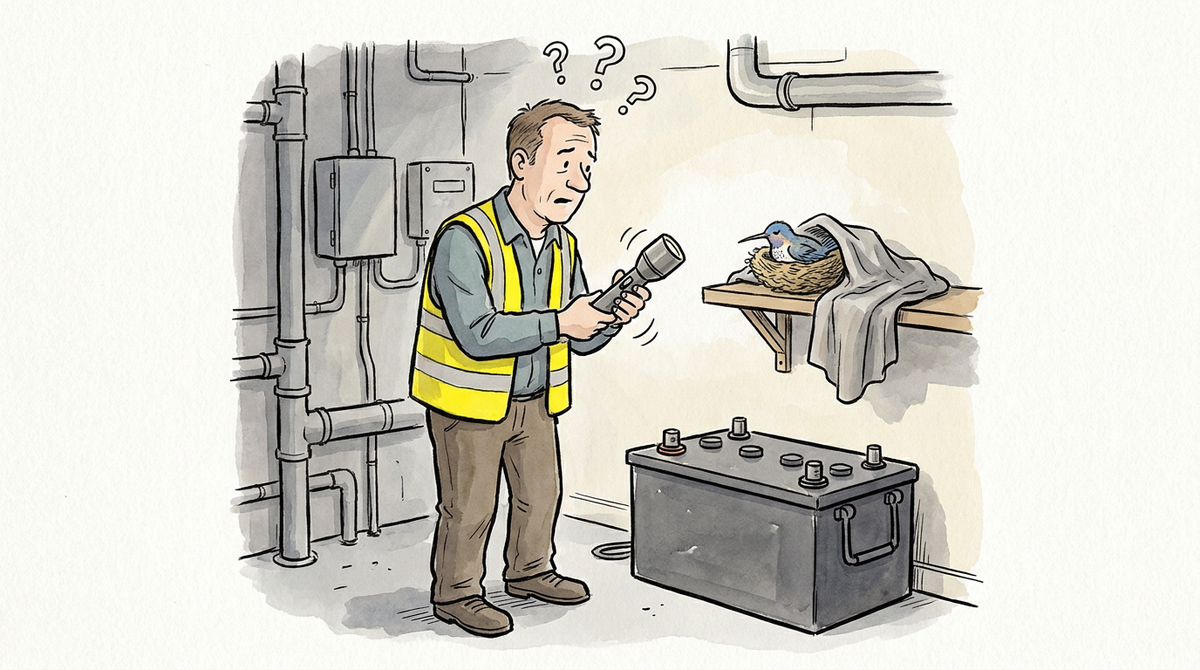
Most of us met Peukert's law long before we heard the name. A torch dies. You put it down, pick it up an hour later, and it lights. Nothing recharged, nothing repaired.
The capacity was never destroyed, only put out of reach. Draw gently and the chemistry inside the cell keeps up. Draw hard and the voltage hits its cut-off with material in the middle of the plate still unused. Capacity is not a quantity, as the second article put it. It is a quantity at a rate.
Three things follow, and they are the shape of this article. There is a number hidden inside the usual equation that nobody prints. Whether it helps you or hurts you depends on how big your battery is. And nearly every voice alarm battery in the country sits on the same side of that line.
If you buy this work rather than do it, the middle of this article is arithmetic and you can skip it. The last two sections are yours. The question you need is one sentence long, and it is not a maths question.
The number nobody prints
Wilhelm Peukert wrote his relationship down in 1897. In raw form it fits on one line:
T = C / I^n
Run time T in hours equals a capacity C divided by the discharge current I raised to an exponent n. For a real lead-acid block n exceeds one; at exactly one it would be amps times hours, the arithmetic everybody wishes were true.
The sting is in C. There is no hour rate in that line anywhere. Set the current to 1 A and it collapses to T = C, so the battery runs for C hours and gives up C ampere-hours. That is the only reading that holds together. C is the capacity at a 1 A discharge, and no sealed lead-acid datasheet I have pulled publishes it.
So the mistake is not exotic. You open a calculator, you have a datasheet in front of you, and you type in the number the datasheet gives you. The equation was never asking for that number.
The one extra term that fixes it
The first article called SmartGauge Electronics my heroes for a fortnight, and they have earned the second mention: they set out, clearly and for nothing, why the raw equation cannot be used with published manufacturer data. Their summary is blunt. "There are many Peukert calculators on the internet that are wrong. They do not work."
Their fix is one extra term, doing one job: turning a rated capacity at a stated hour rate into the 1 A figure the equation wanted.
T = C(C/R)^(n-1) / I^n
Every term is on an ordinary datasheet: C the rated capacity, R the hours it was measured over, I your load.
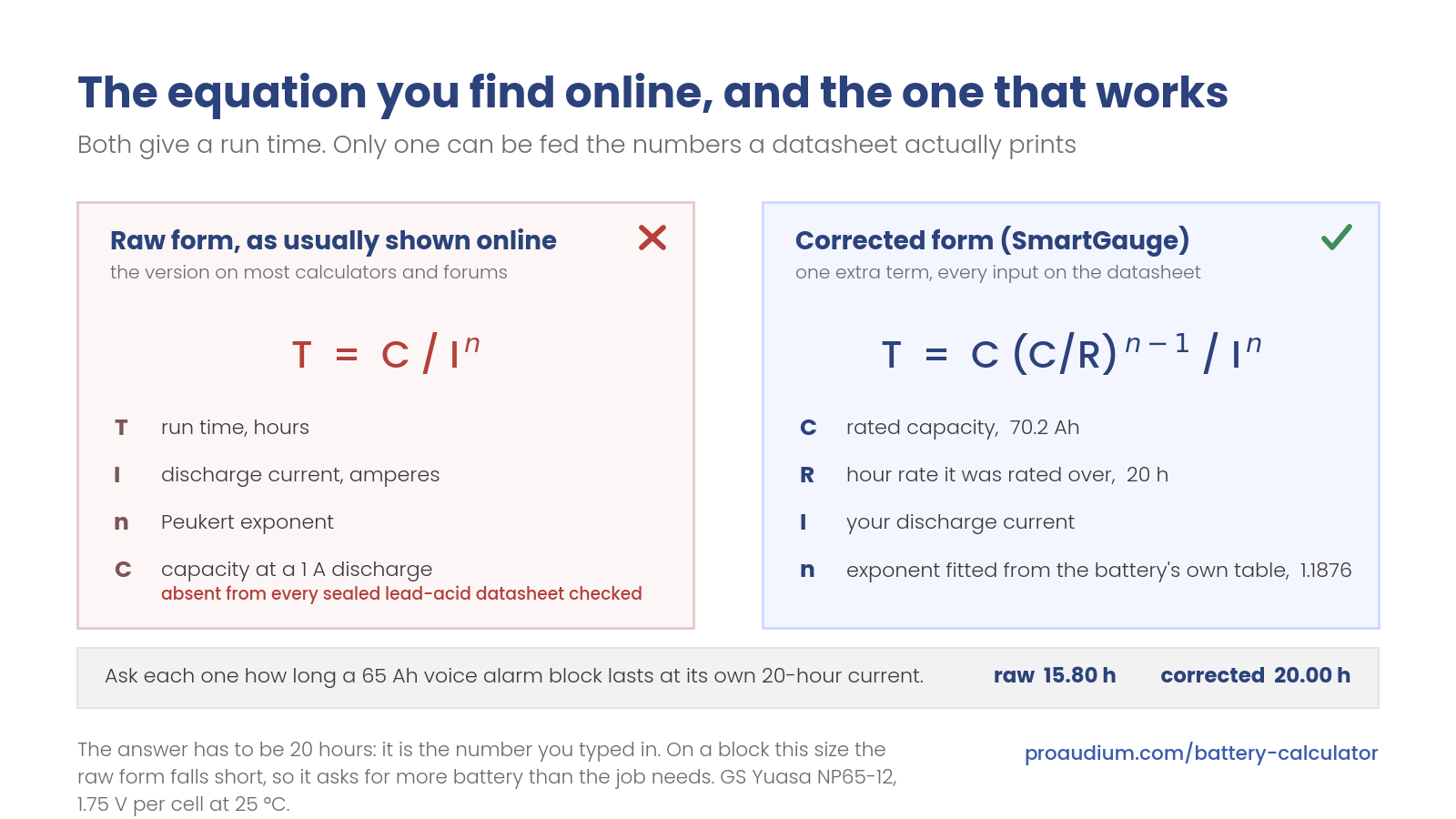
There is a five-second test for the wrong version, and it needs no battery knowledge at all. Hand the equation a battery's 20-hour rating and ask how long it lasts at its 20-hour current. It must answer 20 hours. That is not a prediction; it is the number you just typed in. The corrected form hands it back every time. The raw form, on a 65 Ah block, answers 15.80 hours. Close the tab.
The part I got wrong, and why this article is late
Closing the tab is the easy case. The one that caught me out, and made this article late, is that the raw equation does not always lie in the same direction.
The direction of the error is set by the battery's own nominal current, its rating divided by the hour rate it was rated over. Not by the current you ask about. Below that 1 A anchor it flatters the battery and promises run time that is not there. Above it, the equation runs the other way and under-promises.
Almost every sealed lead-acid block is rated over 20 hours. So the line sits at 20 amp-hours, and it is not a rule of thumb. It is arithmetic: 20 Ah over 20 hours is 1 A.
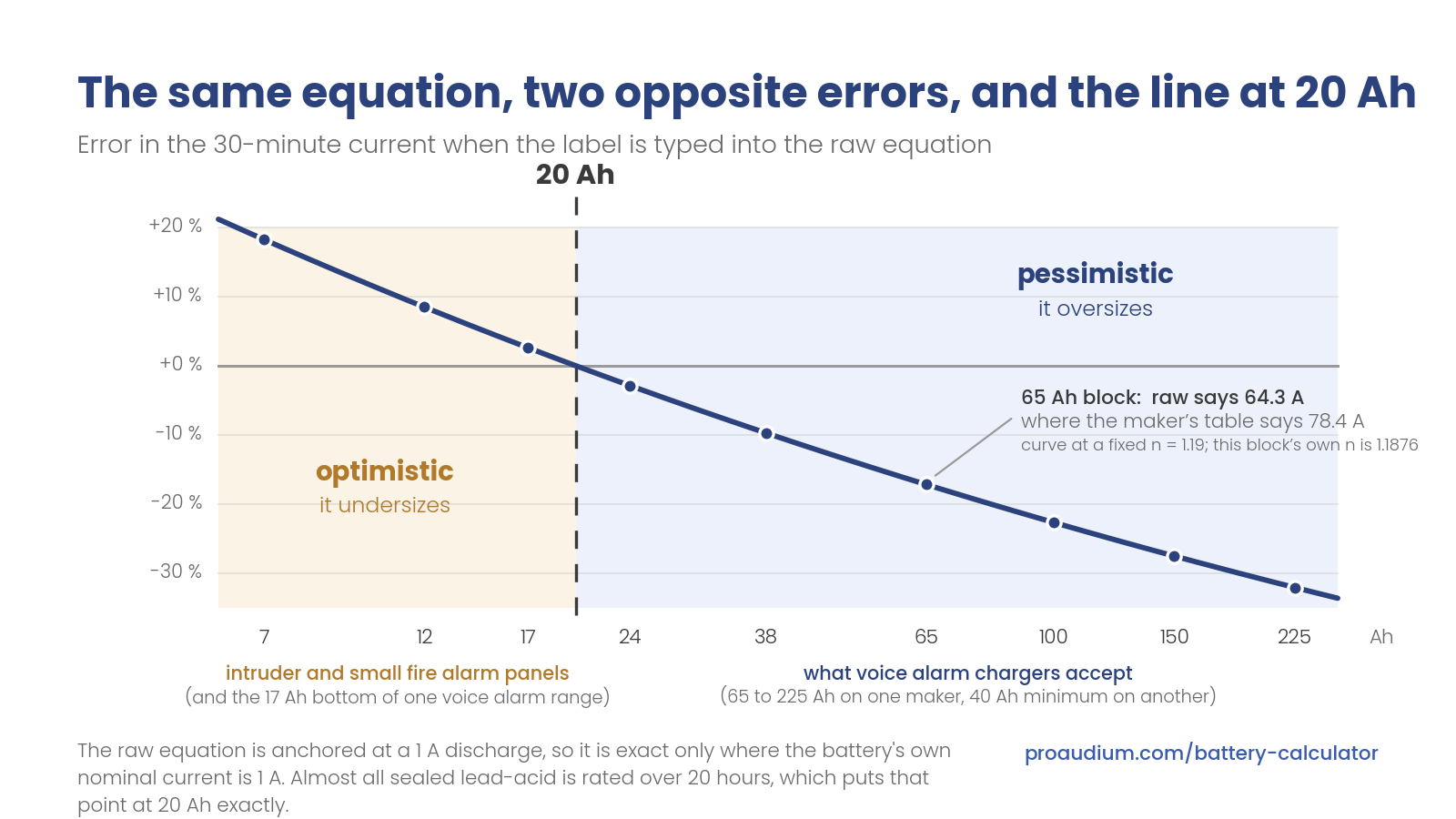
Below the line the error is dangerous. A 12 V 7 Ah block has a nominal current of 0.35 A, and the raw equation over-promises its half-hour current by about 18 %. That block is the one our industry buys by the pallet, and it sits in intruder panels and small fire alarm panels the length of the country. It is not a voice alarm standby battery, and the distinction matters more than it sounds: filing voice alarm under fire alarm is easy to do, and the battery is where the filing shows.
Nearly every voice alarm battery sits on the same side
A voice alarm panel does not take a 7 Ah block, and the manufacturers say so on the page. One maker's voice alarm charger specifies 65 to 225 Ah, another publishes a 40 Ah minimum, a third approves three blocks and none is smaller than 65 Ah. The smallest member of one widely approved range is 24 Ah, which lands just above the line and is as close to it as this industry gets.
So on nearly every block a voice alarm panel takes, the equation is wrong in the safe direction. Work eight real blocks through their own published figures and the raw equation under-states the sustainable 30-minute current by between 16 and 24 %. Fed a 65 Ah block, it says 64.3 A where the maker's own table says 78.4 A.
That is why nobody has found it. An error that shortens the answer never causes a failure, never generates a complaint and never gets investigated. It just gets paid for.
The part where this usually oversells
It gets paid for, but let me be honest about how much. An article like this usually oversells its finding, so I will put a number on it instead.
The error lives in the broadcast term, and the broadcast term is the small one. A voice alarm battery is sized for 24 hours of quiet standby followed by 30 minutes of everything it has, and the standby half dominates the sum.
Take a 24 V bus, amplifiers at 80 % efficiency with speech at one eighth of full amplifier current, the 1.25 ageing factor, and a derating factor of 1.79 taken from the NP65-12's own published table rather than the borrowed 1.9 the fourth article was about. Run 600 W and four zones at 1.5 A quiescent, 1200 W and eight zones at 2.0 A, and 3000 W and sixteen zones at 2.5 A. The wrong equation adds 2.6 %, 3.4 % and 5.4 % to the required capacity. Then the answer gets rounded up to the next block anybody stocks.
So it has been invisible for two reasons rather than one. It errs safe, and it errs small.
Where it stops being small is where the broadcast duty grows. BS 5839-8:2023 extends the half hour where evacuation is likely to run past 20 minutes (Clause 25.3.5 b)), and BS 7827:2019 puts sports grounds on a three-hour duty cycle (Table 2). Take that same 3000 W system out to three hours of broadcast and the wrong equation adds 33 Ah. That is a block, and a heavy one, in a cabinet somebody had to find room for.
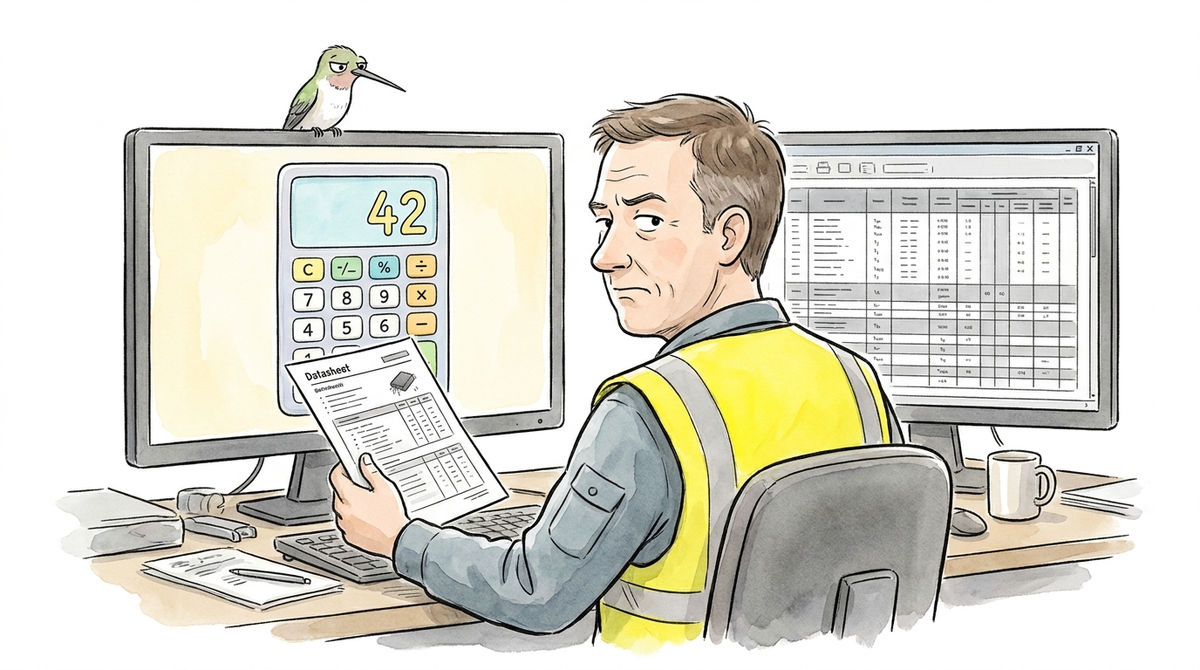
"Why not just use the manufacturer's table and skip the maths?"
You should, and that is the whole argument of the fourth article: a published table is a measurement of that battery, not a curve through two of its corners. Peukert is the fallback for when the table is not there, which for a UK buyer is most of the time. It is also how you check a table you have been given, because a figure out of step with its neighbours by an order of magnitude is a typo, not a battery.
"If it errs safe on my system, why does it matter?"
Three reasons, and none of them is that your batteries are about to fail. It does not err safe on all of it: the 17 Ah block at the bottom of one voice alarm range sits below the line, and so does every ancillary power supply feeding a small load. Safe by accident is not safe by design, and nobody chose that margin, nobody knows how big it is, and it changes with the size of the battery. And it is not free, because it is bought, carried up a riser, sat in a cabinet for four years and then disposed of.
The harshest block, worked both ways
That is what the margin costs. Now watch it happen on a single block, the harshest of the eight I worked through. Its datasheet publishes two numbers you can use: 72 Ah over 20 hours, and 65.0 A for half an hour. Fit the exponent from those two points and it lands at 1.27.
Now ask each equation the half-hour question. The corrected form gives 65.0 A, which is the sheet's own figure, because it was fitted to the sheet. The raw form, handed the same nameplate, says 49.3 A. Hand it the easy question instead, how long the block lasts at its own 20-hour current, and it answers 14 hours rather than 20. Somebody sizing on those numbers would buy a third more battery than the broadcast half of the sum needs, and every check they ran would agree with them, because the same wrong equation would be running the check.
What the equation will not tell you
Trust it for what it is. The law describes a constant-current discharge to a cut-off voltage at one temperature, and nothing else. It says nothing about age, though the exponent worsens as a battery gets older, and nothing about temperature, which moves capacity substantially and holds steady in no riser cupboard I have worked in.
That is not a reason to throw it away. It is a reason to write which battery, which table, which temperature and which exponent beside the answer. A method the industry can agree on for the next revision of BS 5839-8 needs that habit more than it needs better maths.
Two habits, and one line
Three things, then. The equation carries a number nobody prints. Which way it fails depends on the size of your block. And nearly every voice alarm battery sits above the line, where failing means paying rather than risking.
Two habits follow from that. Where a manufacturer publishes a 30-minute figure, use it and keep Peukert for the check. Where none exists, use the corrected form, and make the calculator prove itself on the 20-hour rating before you trust anything else it says.
If the sizing arrives on somebody else's letterhead, the habit is smaller still: ask which battery it was run against, and which of that battery's published figures the derating factor came from. It is not a challenge, and there is a good answer to it. A named block with published figures behind it is the difference between a calculation and a number.
The line at a hundred kilometres is still quoted, and it is still not where the arithmetic puts it. A standby battery has a line of its own, and no say at all in which side of it the arithmetic lands. It is asked for almost nothing for 24 hours, then for everything it has for half an hour, and the second half decides what size it needed to be. Get the arithmetic wrong on that half hour and, on a voice alarm system, the battery will still do its job. You will simply have bought more of it than the job required.

The calculator runs this arithmetic the corrected way, with the exponent fitted from the published data of the battery you name. Free, two minutes, no email, no callback, just the number.
Check a battery calculation now: proaudium.com/battery-calculator
Next in the series: the 1.25 ageing margin, and the data nobody publishes to support it.