
Battery series
The worked example that doesn't work
Third in a short series on standby battery calculations for voice alarm systems. The first article told the story behind the ProAudium Battery Calculator; the second showed why your next battery quote should be smaller than your last. This one answers the question several readers asked under the first: which worked example has the error?

In 1934, Webster's New International Dictionary printed a word that does not exist. Dord, said page 771: density. A filing slip reading "D or d" had been misread as a word. It stayed in the dictionary for five years before an editor paused on it, checked the file, and had it pulled.
Annex C of BS 5839-8:2023 has its own dord.
This article shows you where it is, in three steps: what the worked example is for, the line where its arithmetic fails, and what to do about it while the page stays in print.
A worked example earns a strange kind of trust
The requirements of a standard tell you what must be done; the worked example shows the method doing it, with real numbers, so you can check you have understood. When the formula is dense, the example is the handhold. Technicians do not re-derive it; they follow its shape and substitute their own numbers. Software people go one further: the worked example becomes the test case their code must reproduce.
None of that is laziness. It is what the example is for. It is the reference implementation, and that is exactly why an error inside one costs so much: it does not fail loudly. It produces a number that looks right, sits in a report, is signed off, and buys a real battery for a real building.
Run the example with me
Annex C's example sizes the standby battery for a small voice alarm system. Paraphrased into plain steps (the standard's own wording and layout stay on its page):
The system: 24 V, holding a standby current of 0.35 A for 24 hours, then 30 minutes of emergency broadcast.
The amplifiers: 400 W of rated load at 80 % efficiency, giving a full-load current the example rounds to 20.84 A.
The broadcast current: the standby load, plus 1.5 A of alarm-mode equipment, plus one eighth of the amplifier current, speech being counted at an eighth for the reasons the second article covered. Together: 4.45 A.
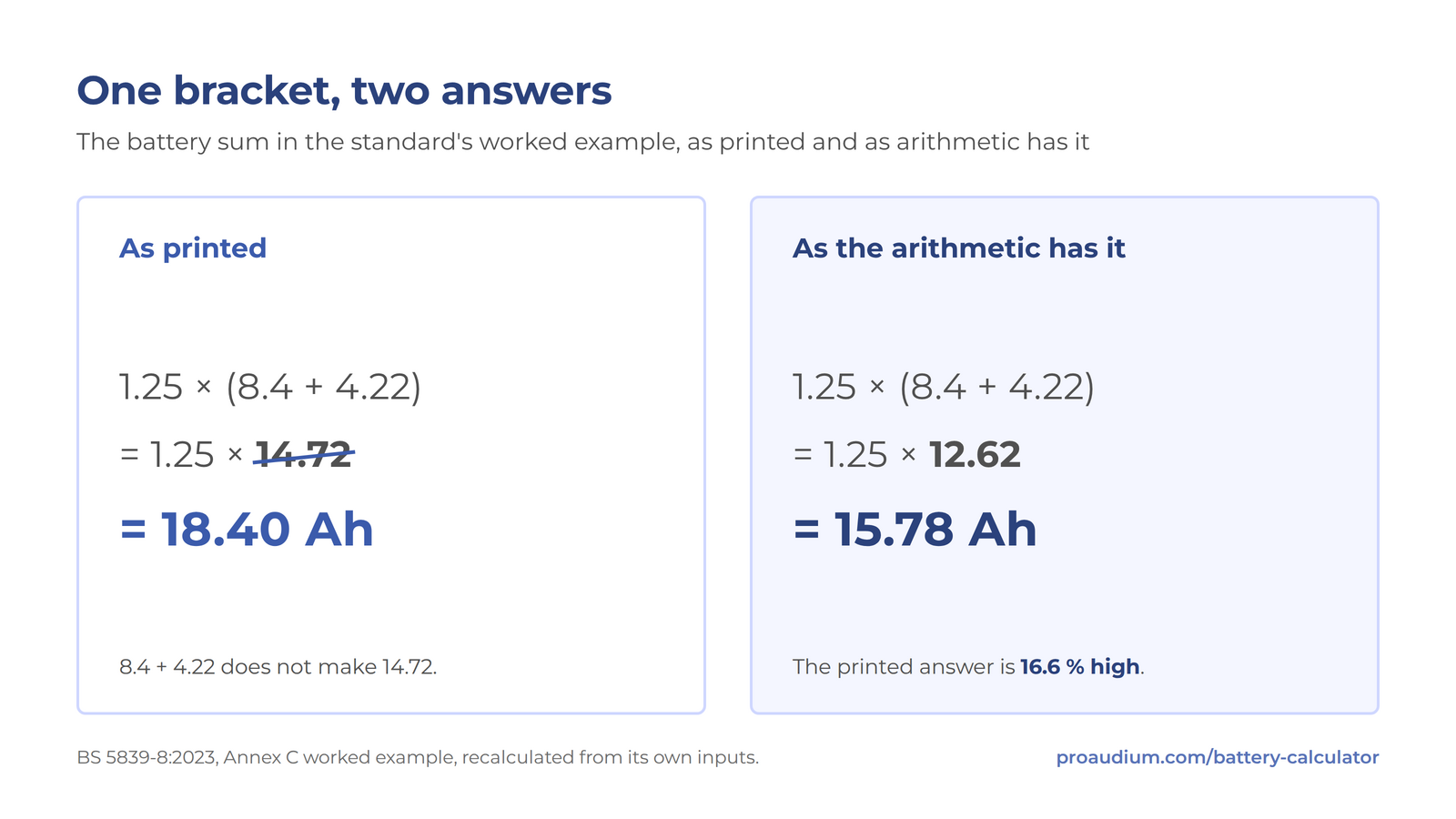
The sum: a standby term of 24 × 0.35 = 8.4, and a broadcast term of 1.9 × 0.5 × 4.45 = 4.22, the 1.9 being the derating factor for a 30-minute discharge and the 0.5 being half an hour in hours. Add the two terms, then multiply the lot by 1.25 as margin for ageing.
So the minimum capacity is 1.25 × (8.4 + 4.22). So far, so checkable.
Now sum the bracket yourself
8.4 plus 4.22 is 12.62. The standard prints 14.72.
The final answer inherits the slip. Multiply the printed 14.72 by 1.25 and the example concludes the system needs 18.40 Ah of battery. Multiply the bracket's own contents by 1.25 and it needs 15.78 Ah. The printed answer is 16.6 % high.
To be thorough: there are a couple of tiny rounding quirks on the same page (20.833 printed as 20.84, 4.2275 as 4.22). They move nothing and they are not the story. The bracket is the story. One addition, in the one place every reader has been taught not to doubt.
Where did 14.72 come from?
Not from a random garble, which may be why it has sat unchallenged. The printed figures are exactly what you get if the 1.25 ageing margin is applied to the standby term on its own, inside the bracket, and then applied again to everything: 1.25 × 8.4 = 10.5, then 10.5 + 4.22 = 14.72, then 14.72 × 1.25 = 18.40. Both printed numbers reproduce to the last digit.
What happened in drafting, only the file card knows. But on that reading the slip carries a certain irony: the margin for batteries growing old, counted twice. The standby half of the example ends up with a 56 % ageing allowance instead of 25 %, and the conclusion oversizes by 2.62 Ah, a sixth of the correct answer.
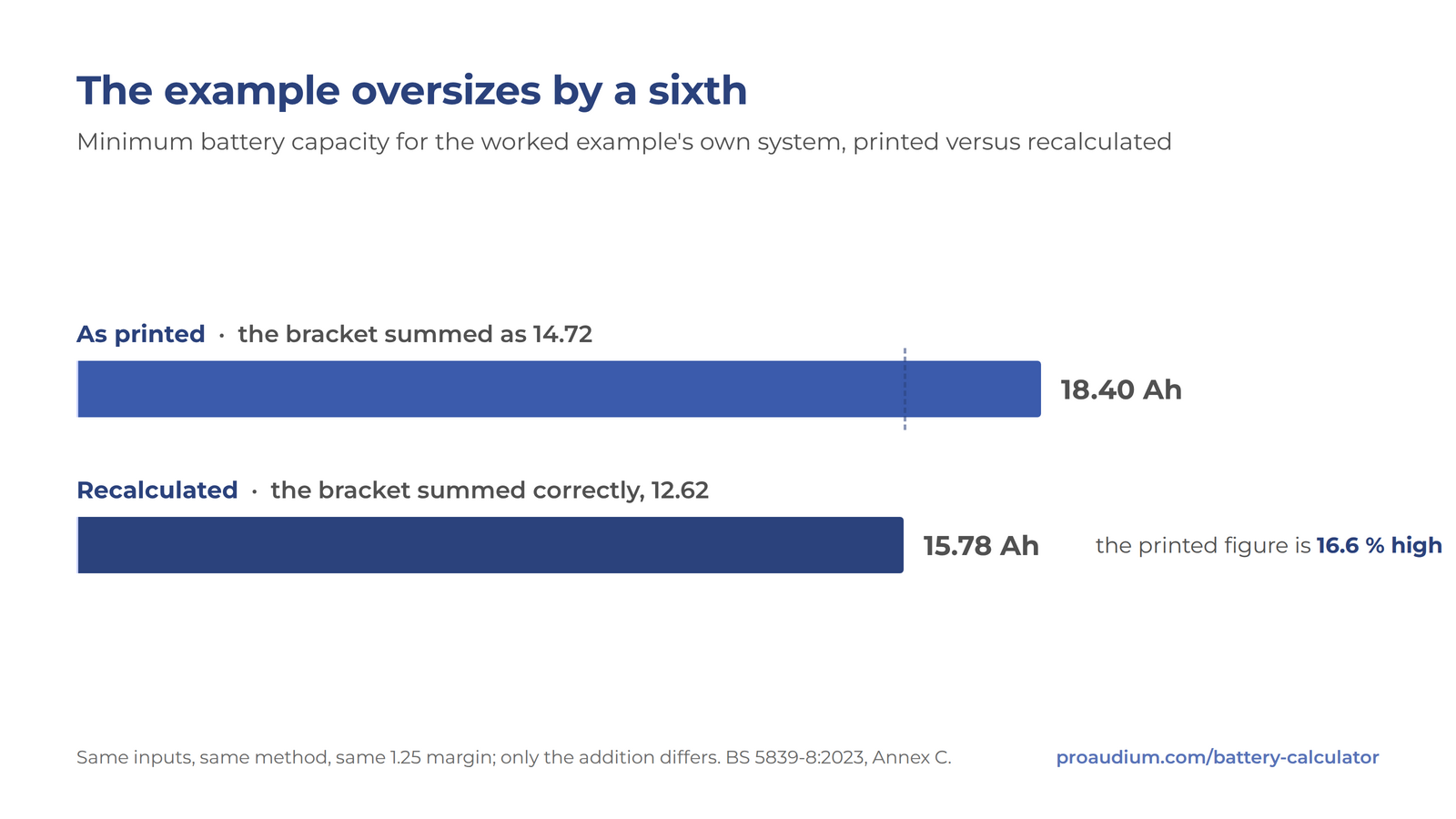
Follow the example and, on its own numbers, you buy capacity nothing asked for: a size up, on the authority of the very page that exists to show you the method. So when does the page get corrected?
Don't wait for the reprint
Before this article was published, the error was raised directly with the lead author of the 2023 edition. Standards have machinery for corrections, and it moves at the pace standards move at: no correction touching Annex C had appeared as this article went to press, and revision cycles run on years. When the page changes is the committee's clock. Your battery calculations run on yours.
So the working assumption has to be that the printed example stays on desks, and in templates, for a while yet. The protection is the check, not the reprint. Re-derive the example once in your own spreadsheet and keep the result. If your arithmetic returns 15.78 Ah from the example's inputs, your spreadsheet is right and the page is wrong, and you have calibrated your tools against the reference rather than the other way round.
But it is only an example
True, and worth saying plainly: the error sits in the arithmetic of an illustrative annex, not in the standard's requirements. The method is sound, the 2023 changes are sound, and nothing in the rules mis-adds. If every technician derived their calculation from the requirements alone, the slip would be a curiosity.
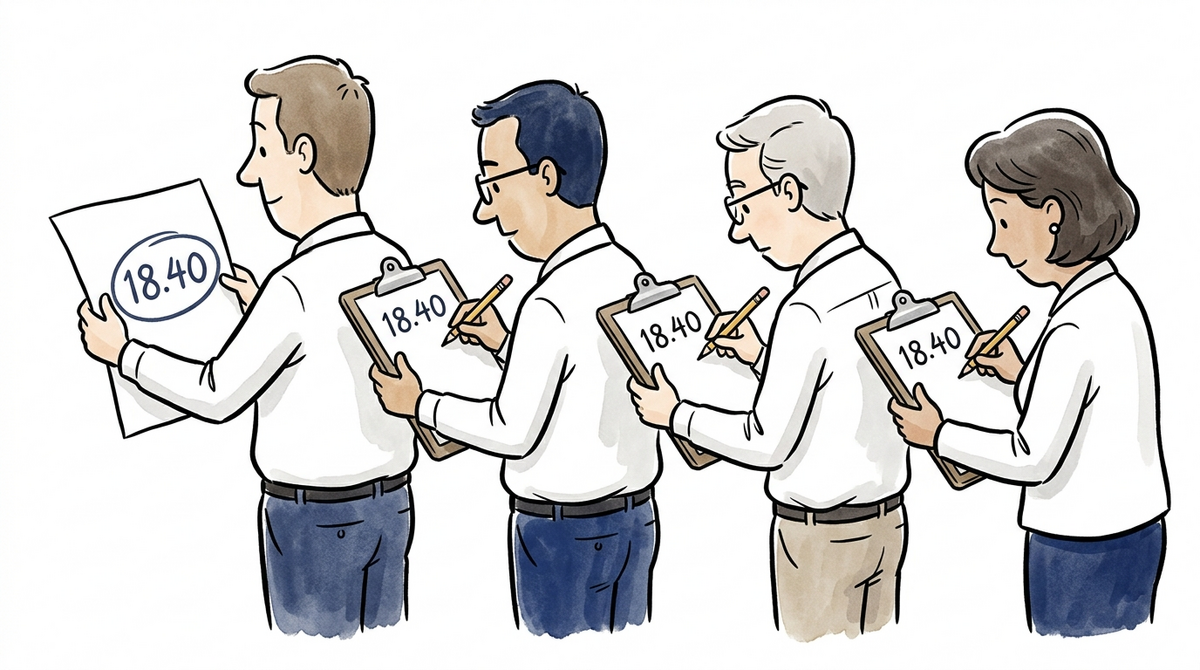
Except that is not how a standard is used, and everyone in the industry knows it. The second article showed how the example's 1.9 derating factor gets lifted straight off the page and applied to batteries it was never measured on. The example's final figure travels the same way: followed, copied into the office template, inherited by the next job and the next hire. A reference implementation is copied precisely because nobody re-derives it. Its errors propagate on the same guarantee.
Surely oversized is the safe kind of wrong?
The gentler objection: 16.6 % high fails in the comfortable direction. Nobody's broadcast dies from too much battery. If a client pays for 2.62 Ah they did not need, that is a pity, not a hazard.
For this slip, on this page, that is correct, and it is one reason the error can sit quietly: an oversized battery never announces itself. But the habit the page teaches has no direction. The dangerous version of this story is the technician who runs the example, gets 15.78, sees the book say 18.40, and corrects a working spreadsheet to match a broken page. A wrong reference answer does not just publish one wrong number. It converts right answers into apparent mistakes, with the full authority of the standard behind it.
When the reference marked my answer wrong
That is not a hypothetical; it is how this error surfaced. When the ProAudium Battery Calculator was being built, Annex C's example was the first test case: if the code could not reproduce the standard's own answer, the code was wrong. It returned 15.78. The page said 18.40. I assumed, as anyone would, that the fault was mine, and went looking for it in the code. Only after re-adding one bracket by hand did I accept the other possibility.
That is the whole article in miniature. The reference is the thing you test against, so while the reference is wrong, every correct tool fails its audition. The fault is in the page, not in you; but you only find that out by checking the page.
Three lines to keep
If this article had to shrink to three lines, they are these. The bracket in Annex C's worked example sums 8.4 + 4.22 as 14.72; the true sum is 12.62, so the printed 18.40 Ah should be 15.78 Ah. The requirements are right and the method is right; the example mis-adds, and it oversizes by a sixth. And if your own arithmetic ever disagrees with a printed reference, re-add the reference before you "fix" your work.
One file card
Dord came out of the dictionary because one editor, passing page 771 on other business, stopped at a word with no history and went to the files. Five years in print; one person looking. The bracket in Annex C has now had its file card pulled too. Until a correction reaches the page, the looking is yours to do on every calculation that leans on it.
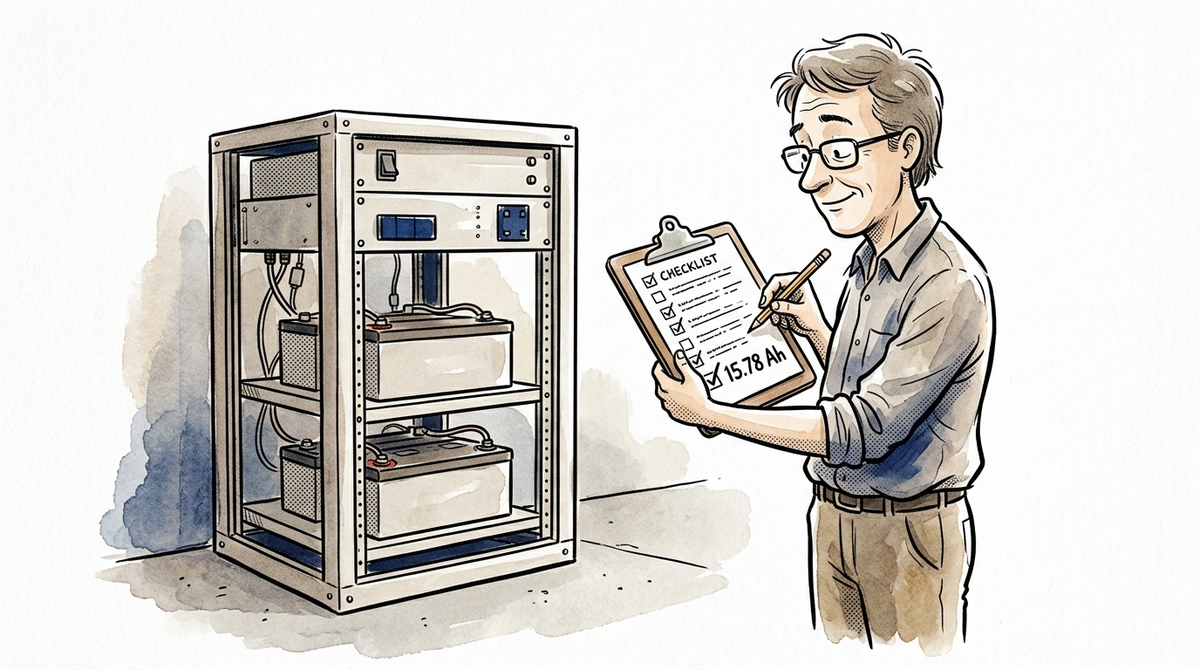
The ProAudium Battery Calculator was tested against this example the hard way, which is why it exists: the 2023 method applied once, correctly, with the arithmetic no longer copied by hand from job to job. Free, two minutes, no email, no callback, just the number.
Check a calculation now: proaudium.com/battery-calculator
Next in the series: what battery manufacturers should publish, but do not.