
Battery series
What battery manufacturers should publish, but do not
Fourth in a short series on standby battery calculations for voice alarm systems. The first told the story behind the ProAudium Battery Calculator; the second showed why your next battery quote should be smaller than your last; the third found the arithmetic slip in the standard's own worked example. This one is addressed to the people who make the batteries, and it ends with an ask small enough to fit on one page.
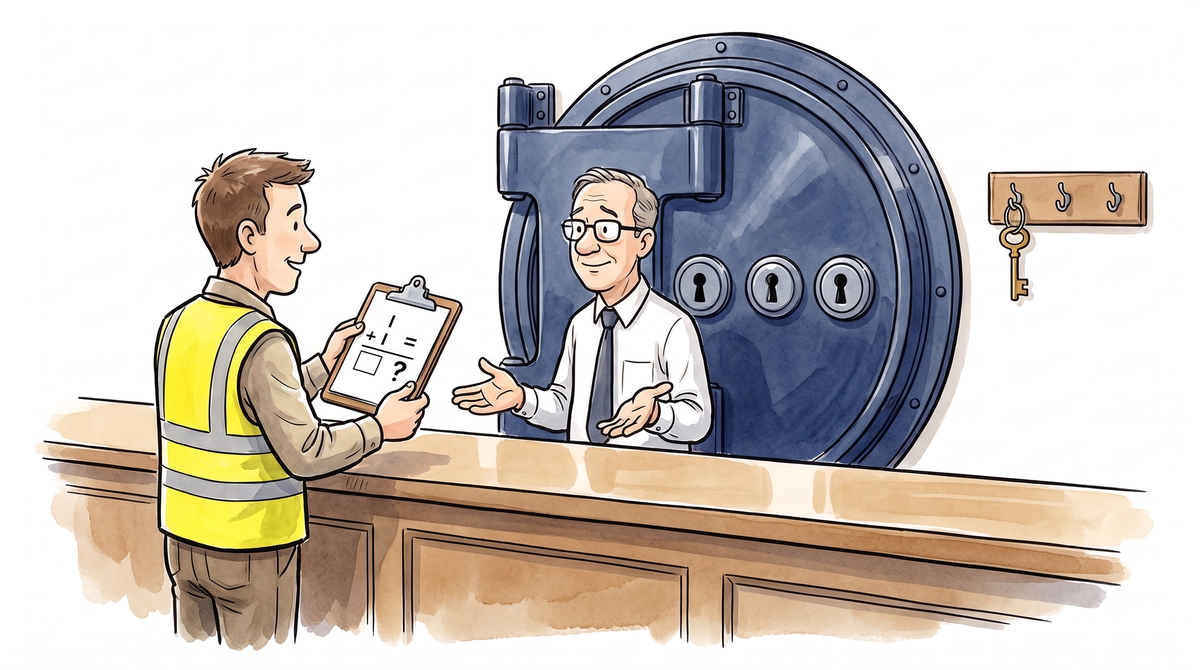
From 1889 to 2019 the kilogram was a small platinum-iridium cylinder kept under three nested bell jars in a vault on the outskirts of Paris, openable only when three separately held keys came together. Roughly once every 40 years it came out to be weighed against its official copies, and by the end the prototype and the copies had drifted some 50 micrograms apart. In 2019 the world stopped queueing at the vault and redefined the kilogram from a constant of nature, so that nobody would ever again need to ask for access.
The number a voice alarm battery calculation stands on lives in a vault of its own. This article is about getting it published.
The calculation needs one number, and the label does not carry it
A Public Address Voice Alarm (PAVA) system's standby battery is sized to BS 5839-8:2023 for 24 hours of quiet standby followed by 30 minutes of full emergency broadcast (Clause 25.3.5 a)). The label describes neither. A "7 Ah" rating is measured over 20 hours, at a gentle 0.35 A, down to a stated end voltage at a stated temperature. Drain the same battery in half an hour and you get much less than 7 Ah. The derating factor says how much less, and the whole calculation stands or falls on it.
The standard says to take that factor from the battery manufacturer's data, and concedes in the same breath that the data is not always published (Annex C, C.1 and C.1.2, Note 2). The second article walked the four routes technicians take to the number and the dead end waiting at each; I will not repeat the tour. The better question is what the datasheets actually hold, and how small the fix would be.
I pulled the datasheets so you would not have to
Start with the battery the industry buys by the pallet: the 12 V 7 Ah block sitting in panels everywhere. Yuasa's current European datasheet for the NP7-12, the sheet a UK buyer downloads today, publishes exactly two capacity figures: 7 Ah at the 20-hour rate and 6.4 Ah at the 10-hour rate. That is the lot. No discharge table, no 30-minute figure, nothing a derating factor could be read from. The 12 Ah and 17 Ah siblings carry the identical one-page format. Nor is this recent: the 2002 US and 2007 UK sheets had no tables either, just headline capacities and curves that stop short. The gap is two decades old.
Now the strange part. GS Yuasa's American arm publishes, for the very same NP7-12, full constant-current and constant-power tables at 25 °C: 12 durations from 5 minutes to 20 hours, four end voltages, and the figure a BS 5839-8 calculation wants sitting right in the grid, 7.90 A for 30 minutes at 1.75 V per cell. Same battery, same brand. The table exists in America and is absent from every European sheet I could find.
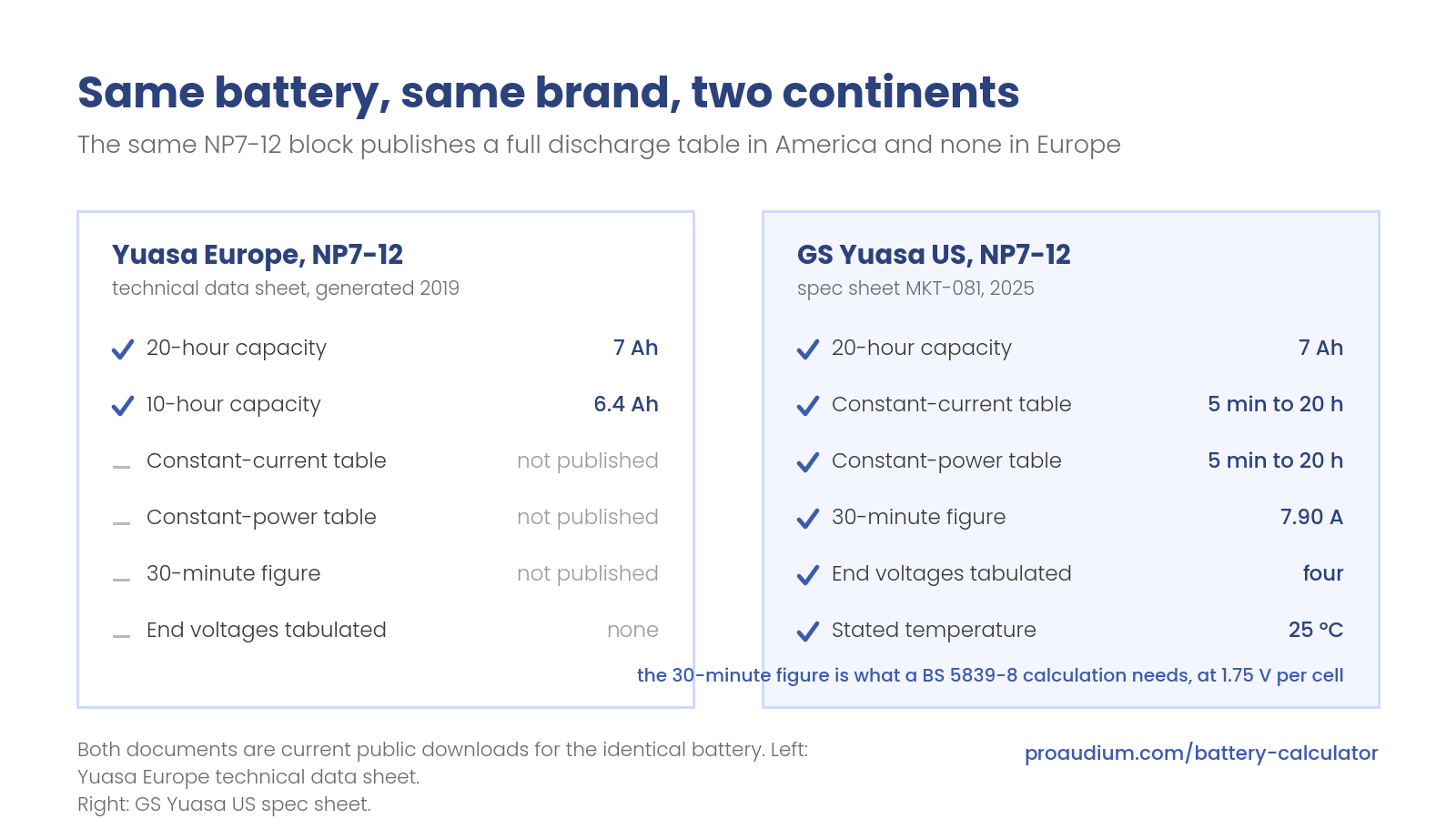
Others simply publish. Fiamm prints both tables for its 7.2 Ah block, at six end voltages, at a stated 25 °C, on the ordinary free two-page datasheet. CSB, Ultracell and Power-Sonic print usable tables too. And a quiet pattern helps the case: every table I pulled includes a 30-minute column, and all but one a legible 1.75 V-per-cell row, which is exactly the pairing the calculation needs. The industry problem is not tables missing the half-hour point. It is sheets with no table.
Six published tables, six different answers
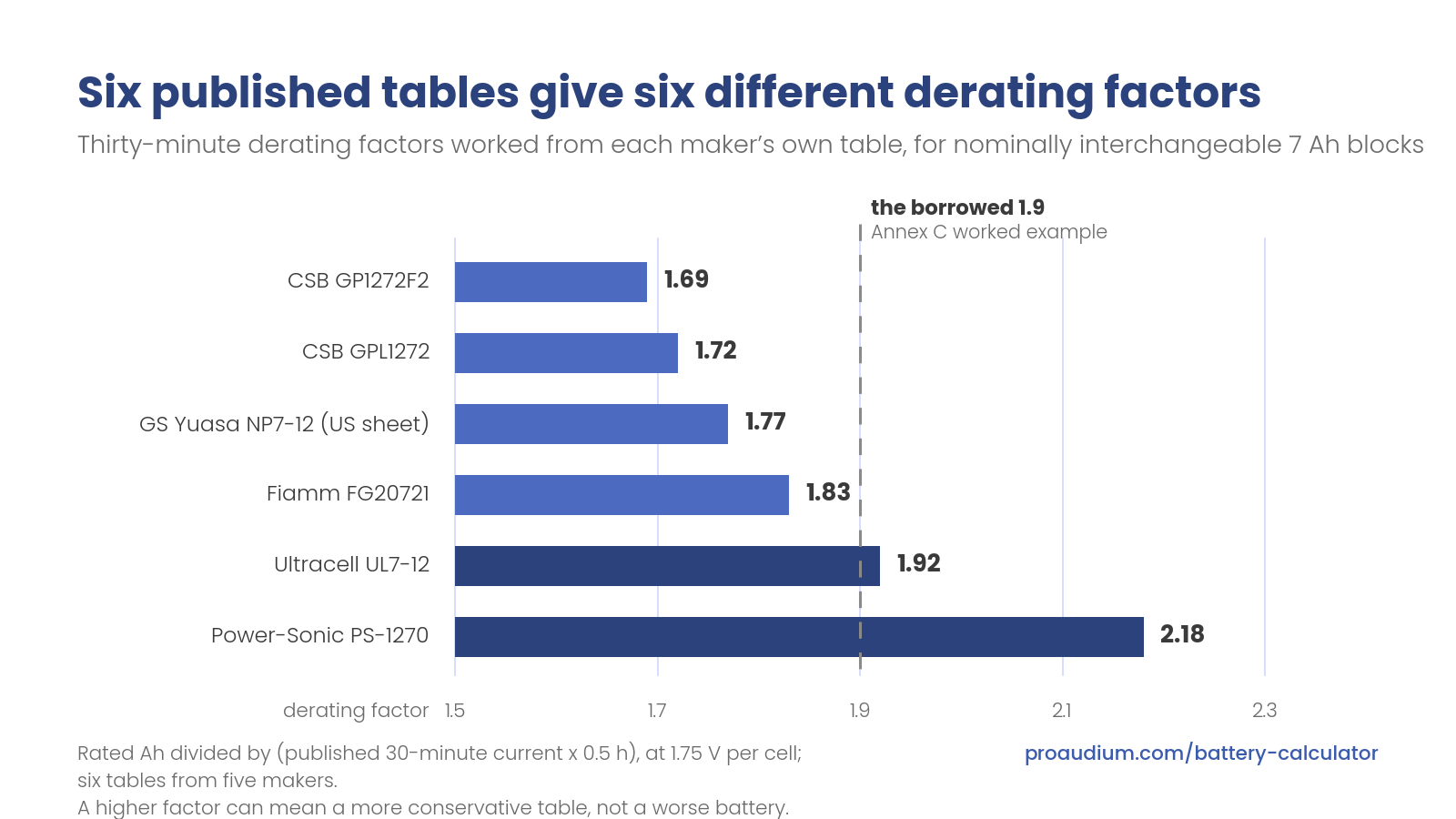
Where tables do exist, the manufacturers' own figures make the argument for publishing. Work the 30-minute currents through and nominally interchangeable 7 Ah blocks return derating factors from 1.69 to 2.18. The block from the second article that sustains 6.43 A for half an hour, a Power-Sonic PS-1270 as it happens, works out at 2.18. The worked example's borrowed 1.9 sits mid-pack, with real batteries scattered roughly 10 to 15 % either side of it, on their own published data. One inherited number cannot speak for every battery on the market, and here are six published tables quietly agreeing.
Why the gap is there
I do not think anything sinister is going on. Three ordinary reasons cover it.
The 20-hour rating is the marketing number. It is the biggest honest figure the battery will ever produce, it goes on the label, and a short-duration table flatters nobody's amp-hours.
Standby voice alarm is a tiny slice of the market. The volume is in uninterruptible power supply work, which is why one maker's headline ratings are watts per cell at 5 and 15 minutes. Our half-hour duty is nobody's shop window.
And almost nobody asks in writing. The evidence is on the sheets themselves: one otherwise excellent table prints a 1-hour figure 10 times smaller than its own column pattern allows, a typo that survives only where nobody is reading. Data that is never queried is data nobody proof-reads.
"The data is in the curves, if you know how to read them"
Sometimes it is, and I have spent evenings proving it. Three problems. First, reading a value off a printed log-log curve is an estimate, and an estimate is not a number to sign a compliance calculation against. Second, the bases shift under you: capacity rated at 20 °C on Yuasa's European sheets, 25 °C on most others, one older sheet quoting its 20-hour rating at 30 °C and its shorter rates at 20 °C on the same page, and one current sheet whose tables state no temperature at all. Third, even the labels disagree: one maker rates its "7 Ah" to 1.80 V per cell where the rest use 1.75, so identical labels are not measured to the same end point. Extracting a defensible factor from all this is expert work. A published table removes the need for it, which is the whole point.

"Wouldn't a 30-minute figure just invite misuse?"
This is the objection I would raise if I made batteries: publish a short-duration figure and someone, somewhere, will design to it badly and wave your datasheet at you afterwards.
But the misuse is already happening, in the opposite direction. Today, a technician who cannot find your figure borrows 1.9 from the standard's worked example, a factor resting on one manufacturer's decades-old data, as the second article traced (Annex C, C.3). Your battery is being sized on somebody else's number right now. A table under your own revision control is protection, not exposure, and at least six manufacturers already carry that risk on free public PDFs. As for margin, the standard applies its own: 1.25 for ageing, on top of whatever your table says (Annex C, C.1.2).
The table I am asking for
Here is the ask, kept deliberately small. Every element except the last already ships on somebody's free datasheet, so none of it is unachievable.
- Constant-current and constant-power discharge tables. Fiamm, CSB, Ultracell, Power-Sonic and GS Yuasa's American arm all print both.
- Durations from 5 minutes to 20 hours, including 30 minutes. All of the above manage it.
- At least four end voltages, including 1.75 V per cell. Power-Sonic prints seven; Fiamm and Ultracell six.
- The temperature the table applies at, which all but one current sheet remember to say, and ideally the correction factors for ambients below it; at least one maker's technical manual prints those already.
- And the genuinely new lines: the capacity the battery is deemed to hold at end of life, and the tolerance on delivered capacity when new. Of every datasheet I pulled, none publishes either, which means the 1.25 ageing margin the whole industry applies rests on data no datasheet provides.
Two tables and a handful of footnotes, on the PDF you already give away. Fiamm's two-page sheet is most of the way there today, and GS Yuasa's American sheet proves a manufacturer can publish the tables for the exact block its European sheet leaves blank.
What happens once the number is out
The ProAudium Battery Calculator names batteries. Pick a block and the 2023 method runs against that block's own published data instead of a borrowed factor; every table published in the form above becomes another battery a technician can size honestly, and cite.
The series' larger aim needs the same thing. A clearer calculation method for the next revision of BS 5839-8 only works if the figures the method asks for are figures the industry publishes; method and data have to meet in the middle. If you make batteries and any number in this article misreads your sheets, tell me and I will correct it in public. If you would rather answer by publishing the table, better still.
Out of the vault
The kilogram spent 130 years behind three keys, drifting quietly while every scale on earth depended on it, and the eventual fix was not better keys. It was publishing the definition where anyone could reach it. A battery's half-hour discharge current is nobody's crown jewels; it is a constant of the product, waiting to be published. The vault is optional.
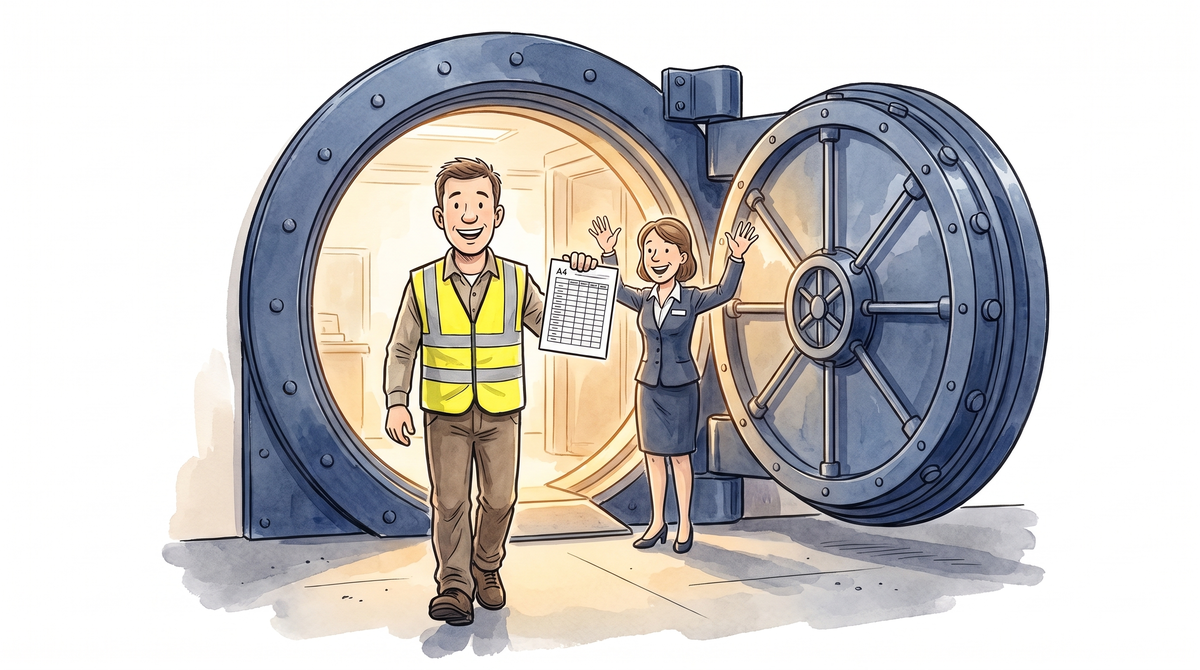
Until the tables arrive, the calculator does the extraction for you: the BS 5839-8:2023 method, Peukert's law in its corrected form, run against the battery you name. Free, two minutes, no email, no callback, just the number.
Check a battery calculation now: proaudium.com/battery-calculator
Next in the series: Peukert's Law explained plainly, for voice alarm technicians rather than battery physicists.
Where this comes from
Every requirement this page relies on, with its clause, our explanation in our own words, and the official source to check it against. We paraphrase the standards; we do not reproduce their text.
| What the article says | Source | In our words | Official source |
|---|---|---|---|
| 24 hours of standby, then 30 minutes of full emergency broadcast | BS 5839-8:2023, Clause 25.3.5 | Our explanation | BSI: BS 5839-8 |
| Derating factors are taken from the battery manufacturer's data | BS 5839-8:2023, Annex C, C.1 | Our explanation | BSI: BS 5839-8 |
| The data is not always published; the 1.25 margin for temperature and ageing | BS 5839-8:2023, Annex C, C.1.2 and its notes | Our explanation | BSI: BS 5839-8 |
| The worked example's derating factor of 1.9 | BS 5839-8:2023, Annex C, C.3 | Our explanation | BSI: BS 5839-8 |