
Battery series · Part 2 of 7
Your next voice alarm battery quote should be smaller than your last
The 2023 edition of BS 5839-8 rewrote the standby battery arithmetic. This article covers what changed, and why the correct new number is surprisingly hard to get by yourself.
Second in a series on standby battery calculations for voice alarm systems. The first article told the story of the rabbit hole behind the ProAudium Battery Calculator; this one is for anyone who signs a battery quote, and anyone who writes one.
In 1851, a German physician averaged more than a million thermometer readings and declared that healthy humans run at 37 °C. Textbooks have copied him ever since. When researchers re-measured in 2020, the average came out at 36.6 °C.
The arithmetic behind your voice alarm batteries has just had the same re-measurement.
The arithmetic changed while nobody was looking
The standby batteries behind a Public Address Voice Alarm (PAVA) system run to the battery maker's recommended life, on a type the standard requires to be good for at least four years in service, so a quote is never far away (BS 5839-8:2023, Clause 25.3.2). The battery is sized for 24 hours of standby followed by 30 minutes of full emergency broadcast (Clause 25.3.5 a)). That duty has not changed. What changed, in the 2023 edition of BS 5839-8, is how much current the broadcast is assumed to draw.
Speech is mostly quiet. The louder syllables are brief, and between words there is silence. Earlier editions of the standard played safe and assumed an announcement drew up to half of the amplifier's full current. The 2023 edition, backed by measurement, puts it at one eighth (Annex C, C.2.1).
That measurement has a story, and it surfaced in the comments under this article's companion LinkedIn post. Anthony Smith, lead author of the 2023 edition, described how the figure was settled: he and the late Peter Mapp tested the question by two independent routes, Mapp calculating the acoustic power of the standard's evacuate message, Smith measuring the heat in dummy-load heatsinks with the message playing against a sine wave. Both methods returned 10.4 %. The committee adopted 12.5 %, one eighth, to align with the requirement of the Low Voltage Directive (LVD) assessment.
On a large system the broadcast term dominates the whole calculation. Take 1000 W of loudspeakers on a modern 24 V system: the amplifiers draw roughly 52 A flat out. Under the old assumption the broadcast term needed around 25 Ah of battery; under the 2023 edition, just over 6 Ah.
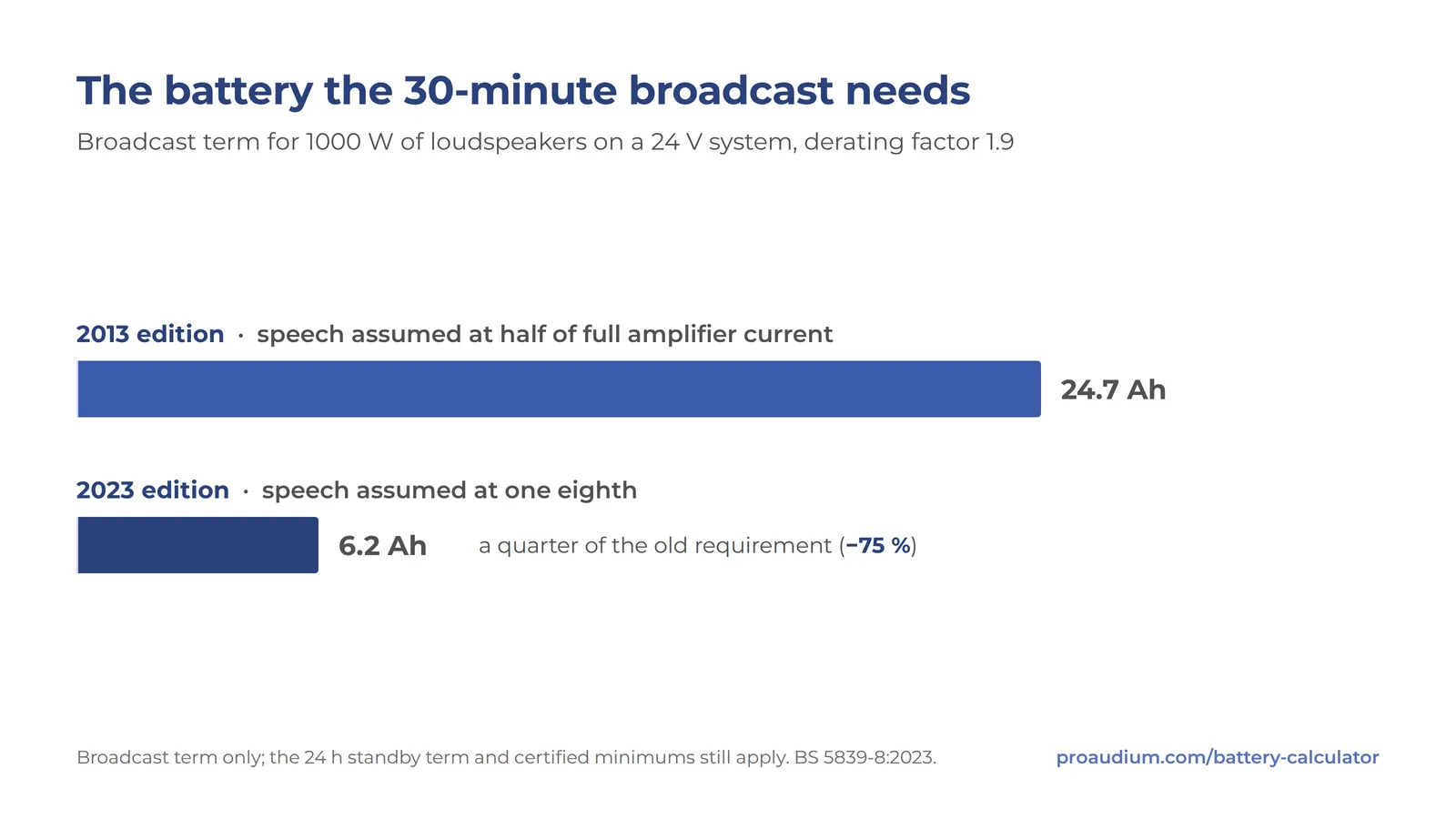
That one change can drop the required battery a full size, sometimes two. A few hundred pounds a set, across every panel on the estate, every replacement cycle. A system sized under the 2013 rules is carrying more battery than the 2023 calculation asks for, and it will keep being resized to the old number every time somebody replaces like-for-like.
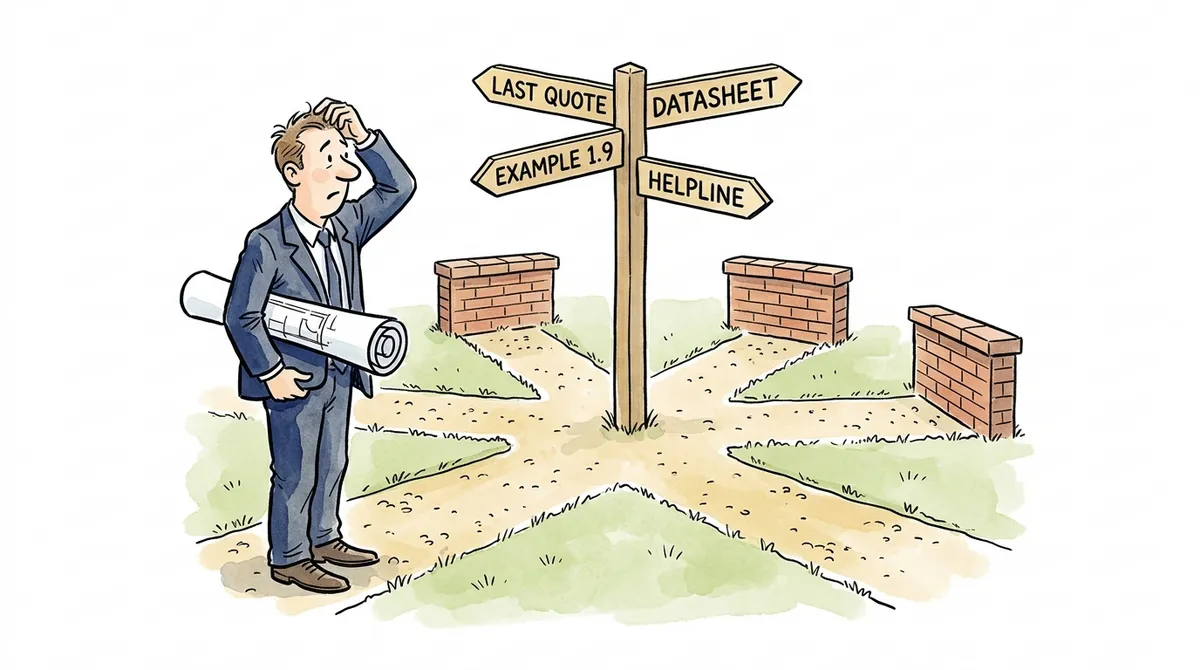
So the new number is smaller. Now try to actually get it.
Four ways to get the number, and where each one ends
The whole calculation stands or falls on one input: the derating factor, a number describing how much of a battery's rated capacity is actually available when you drain it in 30 minutes rather than over the 20 hours the label assumes. The standard says to take it from the battery manufacturer's data (Annex C, C.1). Here is what happens when you try.
Route one: copy the last calculation. The comfortable option, and the industry's default. But the old sheet was built on the 2013 arithmetic, so carrying it forward prices a battery the standard no longer asks for. And if anything has been added since, the old sheet describes a building that no longer exists. A dead end that costs the client money on every cycle.
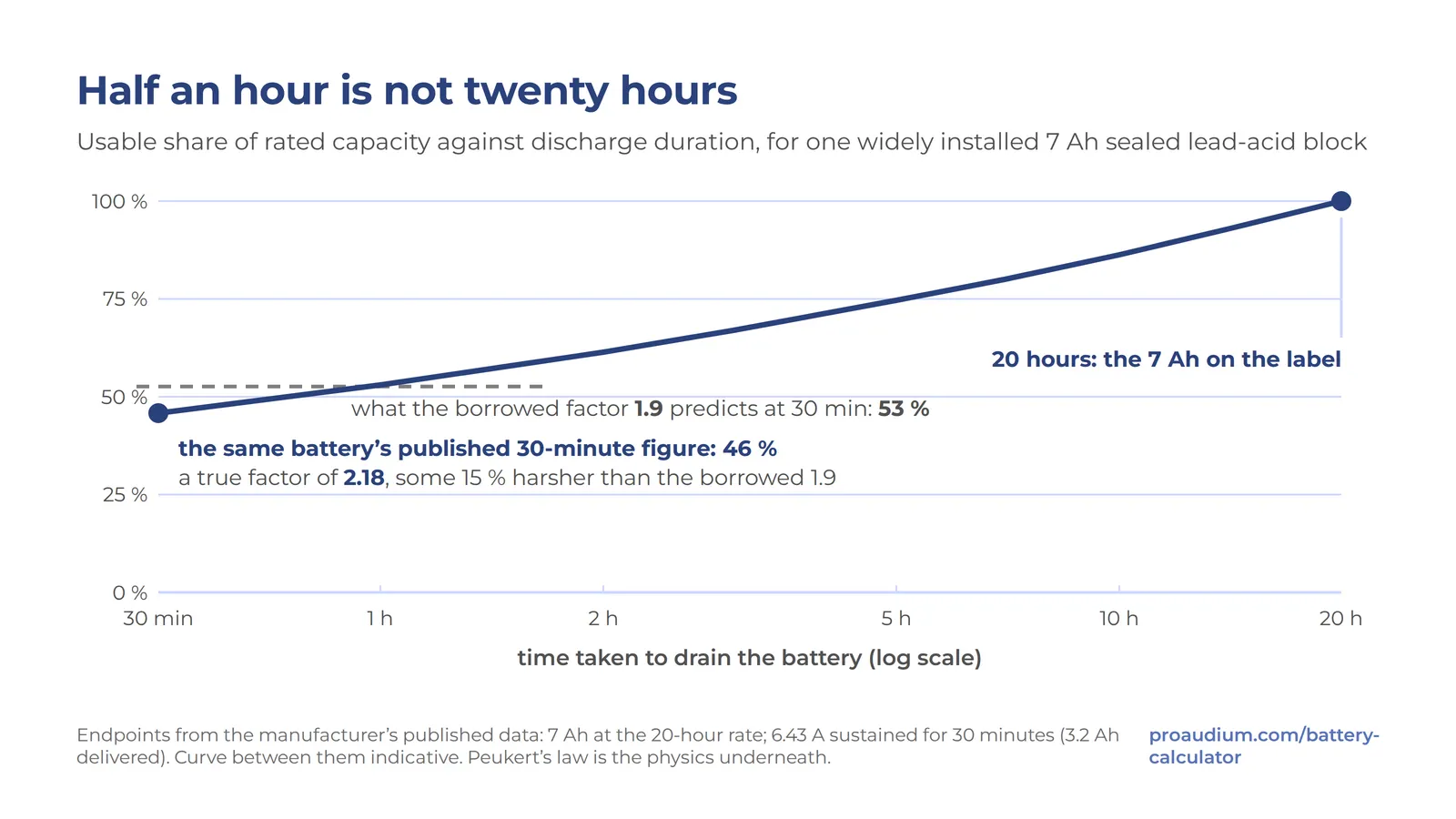
Route two: borrow the standard's worked example. The example uses a derating factor of 1.9, and in practice much of the industry lifts that figure straight off the page (Annex C, C.3). The figure has a history of its own: by Anthony Smith's account in the same thread, it derives from Yuasa data "way back in the day" and has been carried through the BS 5839 series since. One manufacturer's decades-old number, standing in for every battery on the market. Real batteries are not obliged to match it. One widely installed 7 Ah block publishes a discharge table showing it sustains 6.43 A for 30 minutes. Work that through and its true factor is 2.18, some 15 % harsher than the borrowed number. A battery sized to 1.9 comes up short of the very duty it was bought for. Smaller blocks generally fare worse than large ones.
Route three: the datasheet. So take the factor from the battery's own data, as the standard intends. Open the datasheet and look for it. The figure you need, in the form the calculation needs it, is usually not there. Some manufacturers publish constant-current discharge tables it can be derived from, if you know how; many publish only the 20-hour rating and curves that stop short. The standard itself concedes the data is not always published (Annex C, C.1.2, Note 2). You are being asked to build a compliance calculation on numbers the industry does not reliably hand over.
Route four: phone the manufacturer. Ask for the capacity available on a 30-minute discharge, in writing, for your project. The answer, when it comes, is usually the 20-hour rating again, or a general curve, or a promise to escalate. The number exists inside the company; getting it out, signed, against your job, is another matter.
The maths you are left with
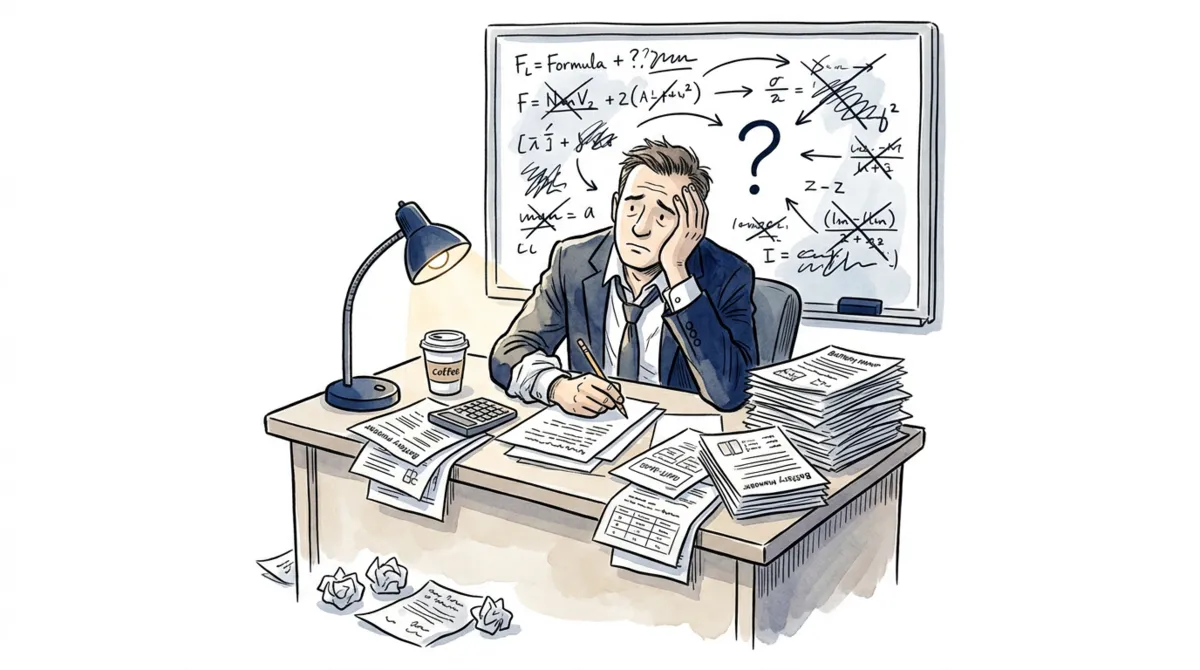
That leaves working it out from first principles. It can be done. Here is what it involves.
The physics underneath the derating factor is Peukert's law, and the easiest way to feel it is on a staircase. Take 100 steps at a sprint and you stop short of the top, and each rest buys back fewer steps than the last; take them steadily and you get there. A lead-acid battery has the same trait, written down in 1897: the faster you draw current from it, the less of its capacity you get to use. It is exactly the effect that matters for a battery that sits quietly for 24 hours and then works hard for half an hour.
Then the trap. Most versions of Peukert's equation in circulation are wrong. Not slightly wrong: wrong in a way that produces confident, tidy, incorrect answers. The raw equation is anchored to the capacity measured at a 1 A discharge, a figure almost no manufacturer publishes. Drop the 20-hour rating into it, the way it is usually shown online, and the maths lies to you. The equation has to be rewritten around the way batteries are actually rated before it means anything at all.
Get past that, and there is still the rest: the two-part duty profile, with speech counted at one eighth of full current and alarm tones at a quarter; the single 1.25 allowance for ageing and temperature; and the floor, because the panel manufacturer certifies a minimum battery for the equipment and no calculation may size below it. Do all of it correctly and you are back at route three, because the corrected method still needs inputs the industry does not reliably publish.
The first article in this series tells the story of learning every step of this the hard way. The short version: weeks of research to produce one defensible number, with a trap at every stage.
Two ways to get it wrong, and they cost you differently
Use a factor that is too generous and the battery is undersized. The system passes its quiet days happily, and the broadcast dies before the 30 minutes it exists to deliver. That is discovered at commissioning if you are lucky, at inspection if you are less lucky, and during an evacuation if you are not.
Play safe and oversize instead, and the quote carries capacity the 2023 standard no longer asks for. Whoever recalculates properly undercuts it and can show the working; a client who accepts it overpays on every panel, every replacement cycle.
Neither error is visible on the certificate. A signed-looking number is not the same as a correct one.
Three cases where the right number goes up
The recalculation is not a guaranteed discount, and it is worth knowing the three cases where the figure must rise.
First, growth. If loudspeakers, amplifiers or zones have been added since the original design, the original calculation describes a building that no longer exists, and the honest recalculation can come back higher.
Second, message structure. The one-eighth figure belongs to speech. If your evacuation broadcast leans heavily on alarm tones, the standard requires a quarter of full current for the tone content, and the discount shrinks accordingly (Annex C, C.2.2).
Third, the floor. The panel manufacturer's certified minimum battery, and the charger's own limits, set a line no recalculation may cross.
"So was I oversold last time?"
No. Under the edition in force at the time, the larger battery was the correct answer, in the same way a fever chart drawn against 37 °C was the right chart until somebody re-measured. The standard changed; the ethics of the people who sized to it did not. What would be hard to defend is quoting the old number after 2023 without checking.
"A smaller life-safety battery sounds like corner-cutting"
The distinction is paperwork. A smaller figure produced by a signed calculation to BS 5839-8:2023, against a named battery's data, checked against the manufacturer's certified minimum, is compliance. A smaller figure with nothing behind it is a corner cut. The question to ask is never "why is this cheaper?" but "show me the calculation."
Before you sign the next battery quote
Three questions do the work. Was this recalculated under BS 5839-8:2023, or is it the old number carried forward? Is the derating factor taken from the battery's own published data, or borrowed from a worked example? And what has changed in the building since the system was designed?
Medicine carried 37 °C for 169 years before anyone re-measured. Your battery quote does not need to wait that long: same building, new measurement, show the working.
Find out how much smaller your next battery quote should be
Getting this number by hand is genuinely hard. That is why the ProAudium Battery Calculator exists: it runs the 2023 method against the battery you name, applies Peukert's law in its corrected form, and is honest about the inputs it needs and why.
Free. Two minutes. No email, no callback, just the number.
Whichever side of the quote you sit on, run it before you sign or send. A smaller number is money back on every cycle; a bigger one is a broadcast that lasts the full half hour. And if yours goes up, better to find out now than at the inspection.
If the batteries sit inside a maintenance contract
Then the quote may never cross your desk: the batteries are replaced inside the contract, on the maker's recommended life. Ask for the calculation to sit beside the battery test in the maintenance report, with the edition, the battery and the derating factor named. On the Recommended and Comprehensive maintenance levels the standby battery is tested as part of the visit, and remedial work is quoted separately from the testing that found it.
See what each maintenance level includes
Checking one quote now? Try the calculator: proaudium.com/battery-calculator
Next in the series: the worked example that does not work.
Where this comes from
Every requirement this page relies on, with its clause, our explanation in our own words, and the official source to check it against. We paraphrase the standards; we do not reproduce their text.
| What the article says | Source | In our words | Official source |
|---|---|---|---|
| A battery type good for at least four years in service | BS 5839-8:2023, Clause 25.3.2 | Our explanation | BSI: BS 5839-8 |
| 24 hours of standby, then 30 minutes of full emergency broadcast | BS 5839-8:2023, Clause 25.3.5 | Our explanation | BSI: BS 5839-8 |
| Speech broadcast drawn at one eighth of full load current | BS 5839-8:2023, Annex C, C.2.1 | Our explanation | BSI: BS 5839-8 |
| Derating factors are taken from the battery manufacturer's data | BS 5839-8:2023, Annex C, C.1 | Our explanation | BSI: BS 5839-8 |
| The worked example's derating factor of 1.9 | BS 5839-8:2023, Annex C, C.3 | Our explanation | BSI: BS 5839-8 |
| The standard concedes the data is not always published | BS 5839-8:2023, Annex C, C.1.2 and its notes | Our explanation | BSI: BS 5839-8 |
| Tone signals drawn at a quarter of full power | BS 5839-8:2023, Annex C, C.2.2 | Our explanation | BSI: BS 5839-8 |