
Battery series
The page I almost turned
The first in a short series on standby battery calculations for voice alarm systems, and the story behind the ProAudium Battery Calculator.

Most of the work I am proudest of began with something I almost ignored. This is the clearest example I have. The ProAudium Battery Calculator exists because of a single line in a standard, spotted at the exact moment my hand was on the page, ready to turn past it.
Here is how a five-second detour turned into a small obsession, and why it ends with a tool you can now use.
A line I nearly missed

When the 2023 edition of BS 5839-8 landed, I did what I always do with a new standard. I sat down and read the whole thing, cover to cover. By the time I reached the standby battery calculation section I was tiring. The formulas there are dense, and I have worked through them many times before. My hand was already lifting the page.
Then I noticed the new one-eighth reduction. A small change, easy to skip, but new. And new things in a standard are never accidental. Someone sat on a committee and argued for that line. I wanted to know why.
The more I looked, the less I understood
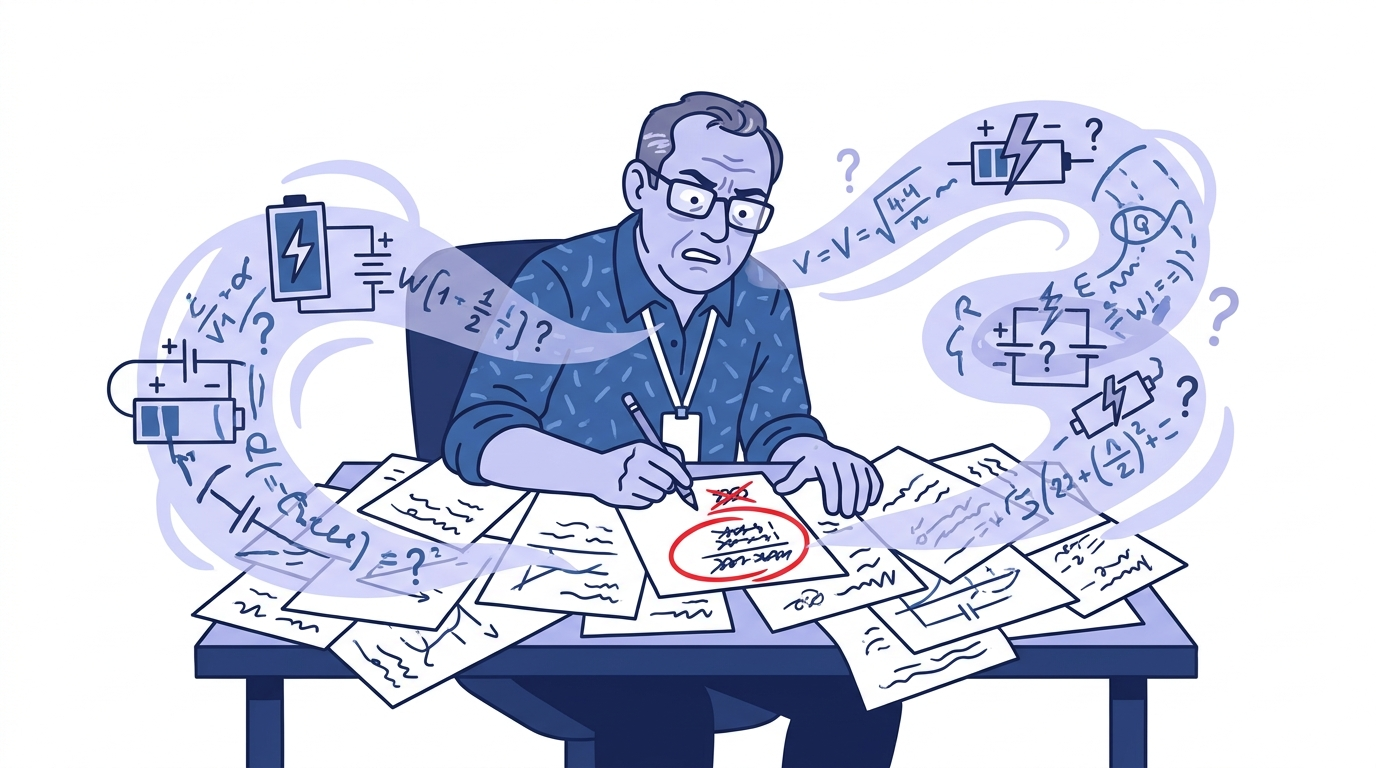
So I did the unglamorous thing. I found a sheet of paper and started working through the formulas by hand. I expected the fog to clear. Instead it thickened. The harder I looked, the less the numbers behaved the way I thought they should.
I went back to the older editions, hoping the previous version would anchor me. Same trouble. So I moved everything into a spreadsheet, entered every variable, and started feeding in values. That helped, and it also turned up something I was not expecting: an error in one of the standard's own worked examples. When the worked example can be wrong, you lose your last handhold.
Where do the numbers even come from?

The worked examples got me moving again, but they raised a sharper question. Where do those starting figures actually come from? Every calculation has to begin with real numbers from a real battery, and that road leads straight to the manufacturers.
So I started downloading specification sheets. Dozens of them. This is where the ground gave way properly. The datasheets are full of holes. The very figures you need to begin a BS 5839-8 calculation, in the form the calculation needs them, are often simply not published. You are asked to build a compliance calculation on numbers nobody will hand you.
Down the Peukert rabbit hole

Chasing those missing figures, I came across something I had never heard of: Peukert's Law. It describes how a battery's usable capacity falls as you draw current from it faster, which is exactly the effect that matters for a voice alarm sitting quietly for hours and then working hard in an evacuation.
That felt like the key. It was, but not before another wall. The versions of Peukert's equation scattered across the internet are mostly wrong. Not slightly wrong. Wrong in a way that produces confident, tidy, incorrect answers. People take the battery's rated capacity, say the figure quoted at the 20-hour rate, and drop it straight into the raw equation. But the raw equation only holds for the capacity measured at a 1 A discharge, a figure almost no manufacturer publishes. Used the common way, the maths lies to you.
The people who got it right

Then I found SmartGauge Electronics, and they became my heroes for a fortnight. They had already written up, clearly and honestly, exactly what I had begun to suspect: that most published interpretations of Peukert's Law are badly wrong, and that the equation has to be rewritten to match the way batteries are actually rated before it means anything at all.
For the first time the whole picture held together. I understood the standard, I understood Peukert, and I understood why so many battery calculations quietly disagree with one another.
The wall at the end
And then the floor dropped one last time. Even with SmartGauge's clarity, even understanding Peukert properly, I was straight back to the problem I had first hit at the datasheets. To do this properly you need figures the manufacturers still do not publish. Understanding the correct method does not help if the industry will not give you the inputs that correct method requires.
That was the moment the calculator stopped being a curiosity and became necessary. If the numbers are hard to find, and the method is widely misunderstood, and even the worked examples can mislead, then the least useful thing I could do was keep it all on my own sheet of paper.
What this is, and where it goes next
The ProAudium Battery Calculator is the result. It takes the BS 5839-8 method, applies Peukert's Law the way it should be applied, and is honest about the figures it needs and why.
This article is the first in a short series. In the pieces that follow I will take the parts one at a time: the error in the worked example, what manufacturers should publish but do not, and Peukert's Law explained plainly for voice alarm engineers rather than for battery physicists.
There is a larger aim behind all of it. I believe the battery calculation section of BS 5839-8 can be made genuinely better, so that the method and the figures the industry actually publishes finally meet in the middle. I do not think that is a one-person job, and I do not pretend to have the finished answer yet. Across this series I want to work towards a clearer method and put it forward as a proposal for the next revision of the standard. If you design, maintain, or manufacture for voice alarm systems, I would welcome your challenge and your input.
It all started with a page I almost turned. I am glad I left my hand where it was.
Try the calculator here: proaudium.com/battery-calculator