
Emergency communication in venues
Attention please: the two worst words to start an emergency announcement
First in a short series on emergency communication in venues, written for the people responsible for one rather than the people who install them. This one is about the words themselves, and how little of what is known about them has reached British practice.
On the evening of 25 January 1990, a Boeing 707 was holding over Long Island, waiting to land at Kennedy. It had been held three times, the weather was poor, and it was running out of fuel.
In the last minutes the captain told his first officer to advise air traffic control that they had an emergency, and that they had no fuel. What the first officer transmitted was, "we're running out of fuel". He never said emergency. He never said mayday. Earlier he had asked for priority.
Air traffic control heard a fuel query. Mayday would have cleared the sky.
Avianca Flight 052 came down at Cove Neck with the loss of 73 lives. The investigators found several causes, including fuel management and a language dimension in the cockpit. But on the communication itself the National Transportation Safety Board was blunt: a total breakdown in communications by the flight crew in its attempts to relay the situation. The academic paper written about it is titled, with no irony available to anybody, "We Need Priority Please".
The crew had the right information. The radio worked perfectly. The words they chose were polite.
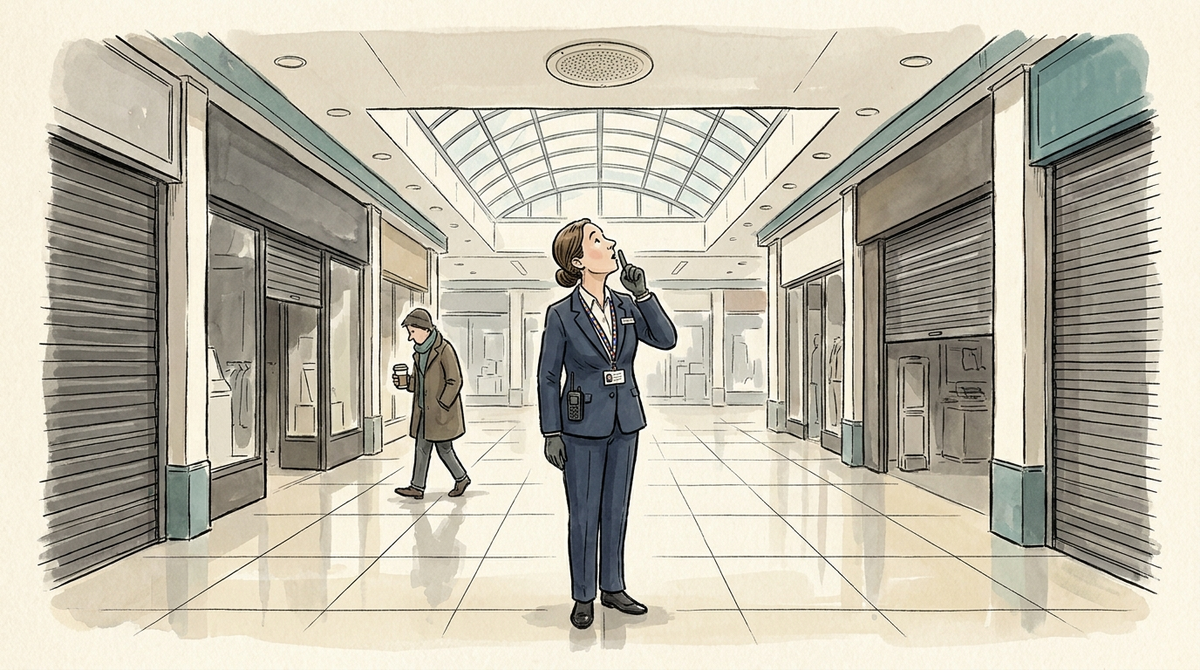
Your voice alarm makes the same choice, to several thousand people at once, and in almost every building in Britain it opens with "Attention please".
Three things follow, and they are the shape of this article. Somebody has tested those words, and they came bottom. There is a set of published rules for emergency messages, free and specific, that the message in your building was almost certainly never held against. And the reason nobody has mentioned it is not that the standard is silent. It is that the standard prints those words itself, in a note, as an example, and the whole industry copied it.
Somebody actually tested the words
Not the audio. The words.
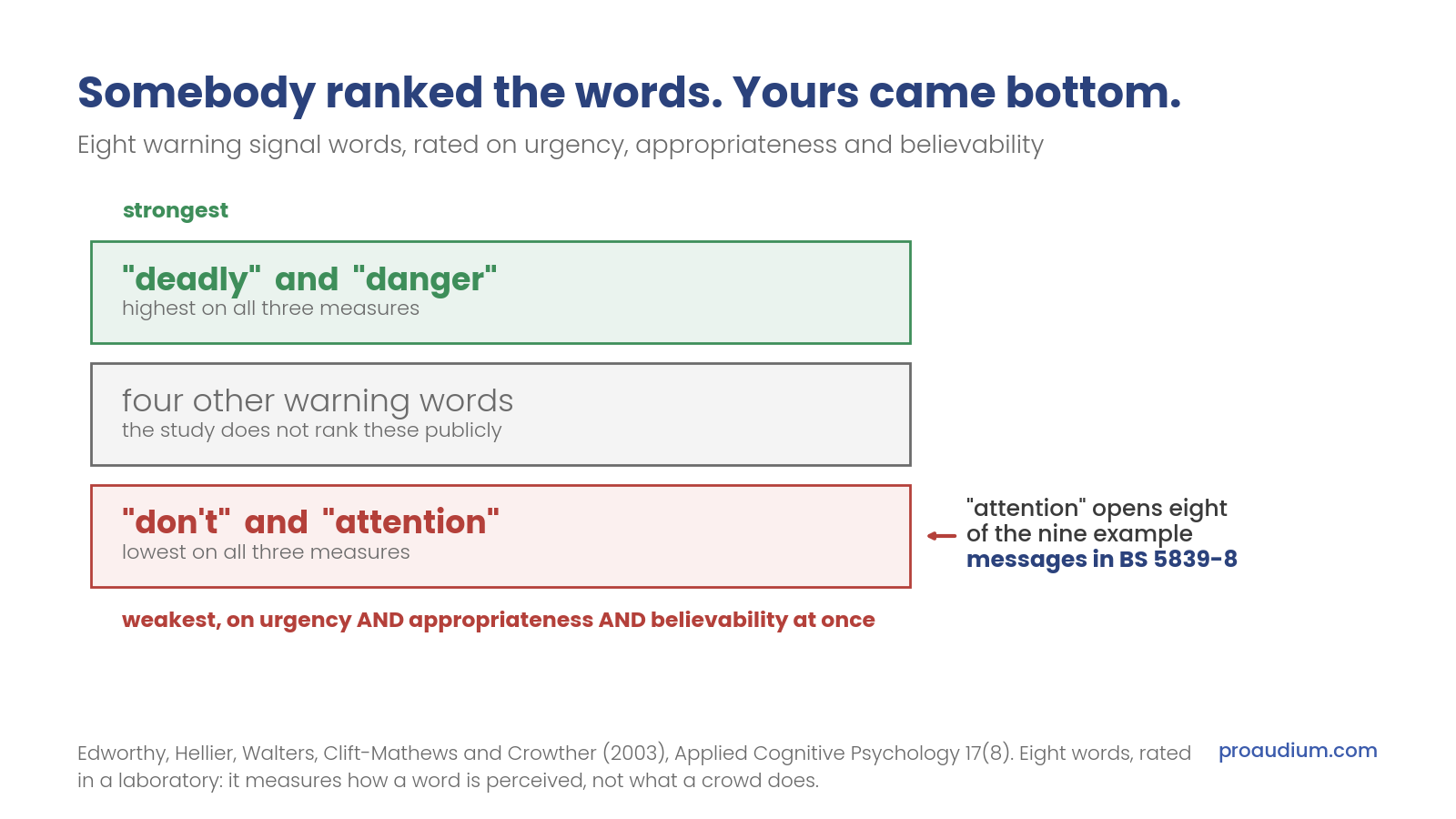
Judy Edworthy and colleagues at the University of Plymouth took eight warning signal words and asked people to rate each one on three things: how urgent it sounded, how appropriate it was to a warning, and how believable it was. Highest were "danger" and "deadly". Lowest, on all three measures at once, were "don't" and "attention".
The three measures moving together is the part worth sitting with. A weak word is not merely less urgent. It is also judged less appropriate and less believable. It does not simply fail to push; it invites doubt. The team also checked the effect was about meaning rather than sound, testing warning words against neutral words matched for phonetic shape. The warning words won.
One honest caveat, because this article is hard on other people's assumptions and should be hard on its own. This was eight words, rated in a laboratory. Nobody was evacuated. It tells you how a word is perceived, not what a crowd does when it hears it.
But it is eight words more than anybody tested before your message library was written.
Somebody wrote the rules down
Nobody tested the words, and nobody held the message that carried them against the rules for writing one. There are rules, free and published, and British voice alarm practice has largely never met them.
The most useful is the American National Institute of Standards and Technology's guidance on emergency messages in buildings, free to download and out since 2014. It says something that should stop any facilities manager in their tracks.
Stress reduces comprehension by about four school years.
That is why the guidance tells you to write emergency messages for the reading age of an eleven-year-old. Not because your occupants are stupid, but because the person receiving the message is not the person who wrote it. The message was drafted by somebody calm, at a desk, reading it. It is received by somebody frightened, on their feet, hearing it once.
Four more rules follow, specific enough to check against your own system this afternoon.
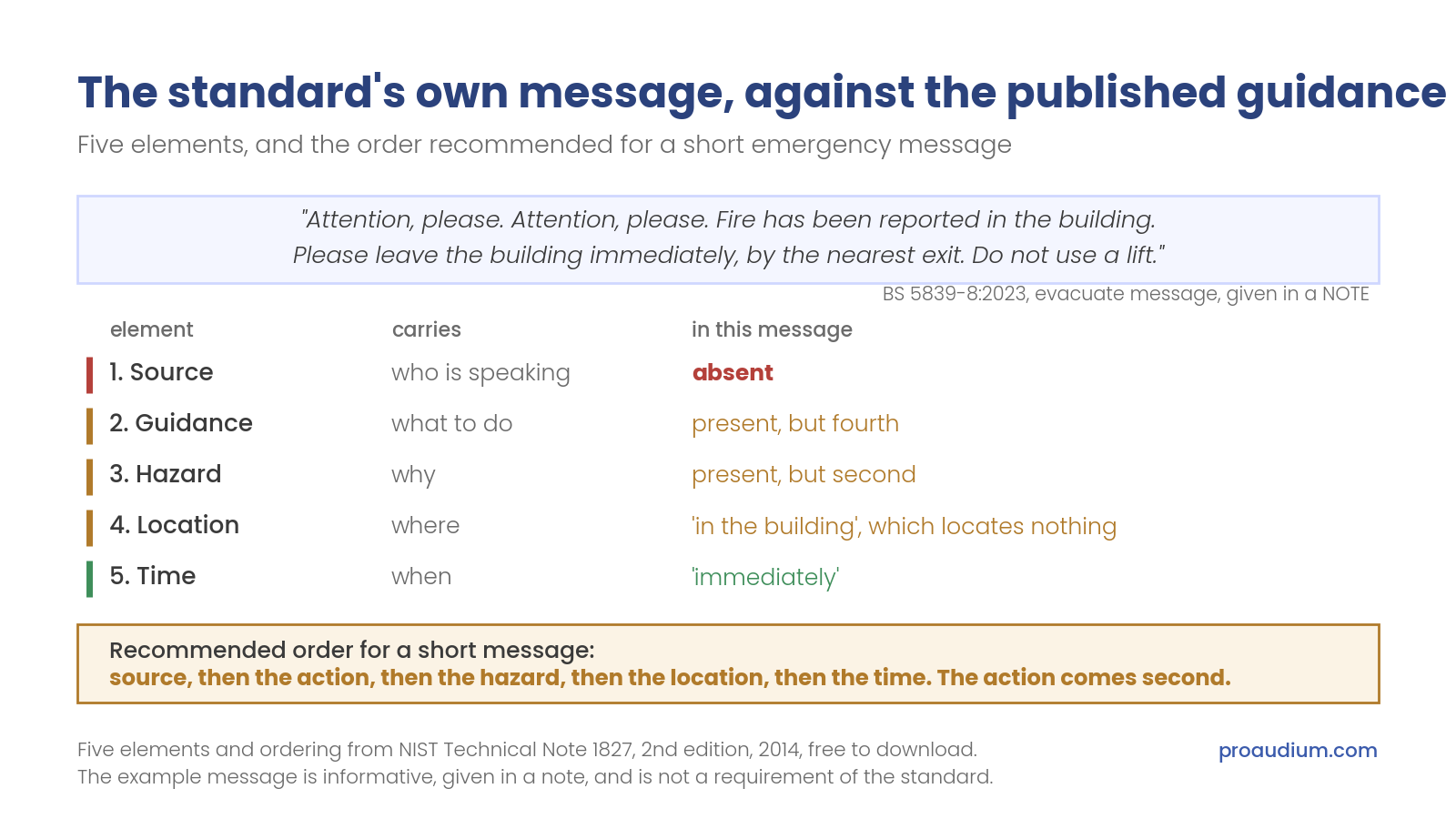
A message needs five elements. Who is sending it, what to do, when to act, where the emergency is, and why. The what and the why matter most. Count how many of the five your own evacuation message carries, and how much each one actually tells somebody.
The order matters, and it is probably not yours. For a short message the recommended order is source, then the action, then the hazard, then the location, then the time. The action comes second. British message libraries almost invariably lead with the hazard and put the action last, which is the order you would choose if you were writing a report rather than trying to move somebody.
Repeat it, in full, twice. Stated in full, then stated in full again, with a gap, rather than clipped or looped over itself. A separate study found that repetition erased the accuracy gap between a message written down and one spoken aloud, which is a large effect for something that costs nothing. Your standard agrees with this one, and says so (BS 5839-8:2023, Clause 18.2).
And slow down to about 175 words a minute, which is slower than most recorded messages and much slower than a nervous person live on a microphone.
It is in the standard, and that is the problem
Anybody who has worked with voice alarm for any length of time can recite these from memory. BS 5839-8 prints example messages, it has printed them through edition after edition, and the wording has barely moved in all that time. The current version gives this as the evacuate message:
"Attention, please. Attention, please. Fire has been reported in the building. Please leave the building immediately, by the nearest exit. Do not use a lift."
And its alert message:
"May I have your attention, please? May I have your attention, please? Fire has been reported in the building. Please listen for further instructions."
Those are two of nine. Clause 18 prints nine examples in all, covering evacuation, alert, phased evacuation, coded staff messages and fire alarm tests. Eight of the nine open with "Attention, please" or "May I have your attention, please?". The one that does not is the line for testing the audio system when nobody is supposed to be listening.
I have read those messages more times than I could count, and it never once occurred to me to check them against anything. That is the trouble with familiarity. They are in the standard, and the standard is the thing you check everything else against.
So read the four emergency examples against the five elements. Not one of them says who is speaking, which is the first element. The three that state a hazard put it before the action, which is the order recommended for a long message and not for a short one. Those same three give the location as "in the building", which locates nothing for somebody standing in it, and the fourth gives no location at all. And eight of the nine open with the word that came bottom of eight, most of them twice over.
The only example in the whole clause that says what is speaking is the ninth: "This is a test of the public address system." The single self-identifying message in Clause 18 is the one meant for a technician.
The words are in a note. The requirement is not.
Now the part that matters most, and the part I had never registered in twenty years of reading them. Those messages appear in notes (Clause 18.8). In a British Standard a note is informative, not normative: it illustrates, it does not require. They were offered as examples of what a message might look like, and they have been copied across the country, edition after edition, as though they were the specification.
And here is what the copying cost, because the requirement was sitting a few inches up the page. Before it prints a single example, the standard says in ordinary recommendation text that an emergency message should be "clear and concise", and should "be assertive and comprise messages that convey the need for immediate action" (Clause 18.2 and Clause 18.5 c)). Then it illustrates that recommendation with a message that asks permission to speak, twice, before mentioning the fire.
This is not a document that never thinks about words, either. A few paragraphs earlier it works through one, recording that concealing a fire from occupants is now deprecated, because people given accurate information are less likely to panic, and that using the word "fire" in the evacuation broadcast is therefore likely to be advantageous (Commentary on Clause 18). Somebody weighed that word and wrote down why. Nobody did the same for the two that come before it.
It is the words in the notes that were never tested, and the words in the notes are the part everybody took.
This is not the first time. The same standard's worked example for battery sizing mis-adds, and the derating factor everyone uses comes from that same example and belongs to somebody else's battery. Three times now, in one document, the illustration has been mistaken for the instruction.
The library that came with your panel was assembled, not written
That is the assumption almost everybody makes and almost nobody examines.
Your message library arrived with the equipment. Somebody at the manufacturer needed a default set, opened the standard, found messages printed in it, and used those. It is what any of us would have done. But it means the wording in your building was never designed for your building, and never held against the guidance by anybody.
"It is only two words. Does it really matter?"
On its own, probably not much. Somebody already looking for the exit will not be stopped by a soft opener.
It matters because of what it indicates. If the first two words came from a note, the rest of the message did too, and the four rules above went unchecked with them. The opening is not the problem. It is the thing you can check in ten seconds that tells you whether the rest was ever thought about at all.
"Our system was signed off as compliant"
It almost certainly was, and nothing here suggests otherwise. If your message is the one printed in the standard, you did exactly what the document in front of you appeared to recommend, and no assessor in Britain would fault you for it.
That is the point rather than the objection to it. Your system can meet every requirement that applies to it, pass its intelligibility measurements, hold its certificate, use the very wording the standard prints, and still broadcast a message missing the first of its five elements, in the wrong order, opened twice with the weakest available word.
Compliance and comprehension are different tests. Only one of them is on your certificate, and the note you copied was never sat for either.
Fix it without adding a word
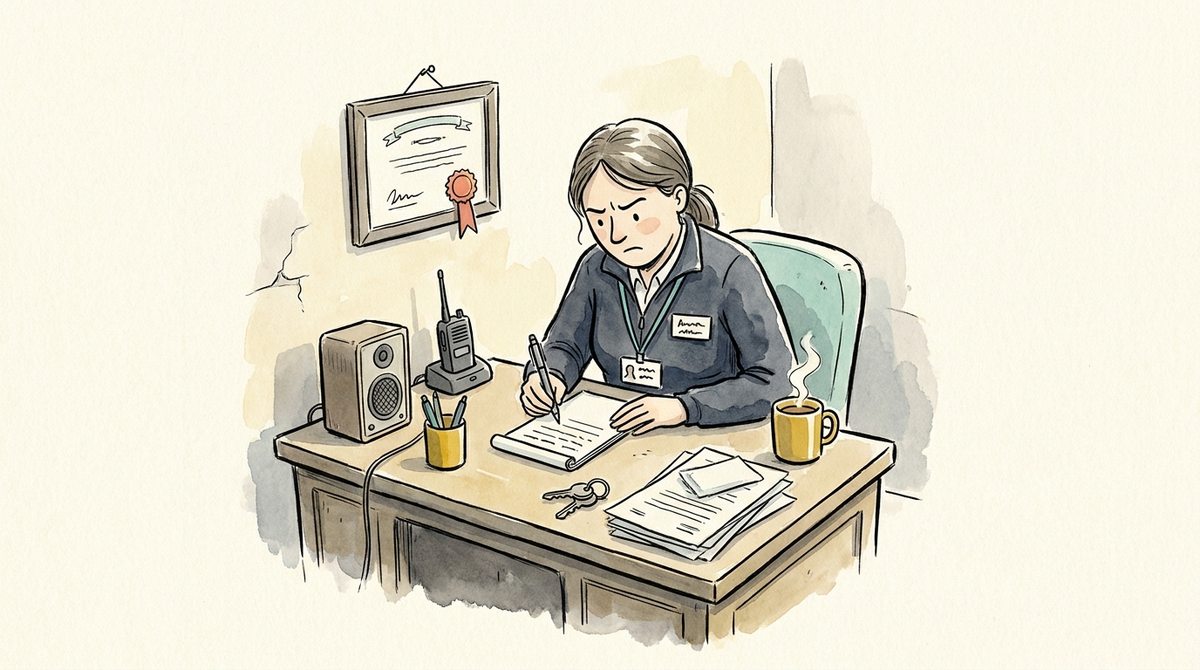
None of that needs a longer message to put right, and that is the part that surprises people. Take the standard's own evacuate message, which is very probably close to yours:
"Attention, please. Attention, please. Fire has been reported in the building. Please leave the building immediately, by the nearest exit. Do not use a lift."
Now rebuild it to the five elements, in the recommended order for a short message, keeping every piece of real information the original carried:
"This is centre management speaking. Leave now by the nearest exit. A fire has been reported. Do not use the lifts."
Twenty-one words, four shorter than the original. The two that opened it, "Attention" and "please", each said twice, bought nothing. Drop them and there is room for the source, the one element the original never had, and words to spare.
It says who is speaking, which the original never does. It puts the action second rather than fourth. It keeps "reported", because a detector operating and a fire burning are not the same thing and the wording should not pretend otherwise. And it keeps the instruction about the lifts, because that is the part people most often get wrong under pressure.
What it does not do is say where the fire is, and that is deliberate. Four of the five elements, who, what, when and why, a single fixed message can carry. Location is the one it cannot. To name a floor you would need a separate message for every zone, or a system that assembles the message from parts as it plays, and neither is something you can rely on today. Worse, the floor would come from the fire detection trigger, and detection is configured poorly often enough that the zone reported is as likely to be wrong as right. A message that names the wrong floor with confidence is more dangerous than one that names none. So "where" stays weak here by necessity, not by oversight, and it is the part of the emergency message the next code of practice most needs to solve.
Every word of the source was paid for out of the opening. "Attention" and "please", twice each, and a location that located nothing. Nothing worth keeping was cut, and the message still came out shorter than the one in the standard.
Your building may need different content, and none of this is the message to adopt wholesale. The point is narrower: the original was an illustration, nobody ever checked it against the recommendation it was illustrating, and once you do, four of its five elements can be put right this afternoon.
Three things, then ten minutes with your own system
Nobody checked it, so here is what to check. The words in your emergency messages were tested by somebody, and the one your building opens with came bottom of eight. The word beside it, "please", was not tested at all, and carries no information either way.
There are five elements, an order, a reading age, a repetition rule and a speech rate, all published and all free. The standard's own example omits the first element, orders the rest the way you would order a report, and gives a location that locates nothing.
And the wording you are using came from a note in your own standard, offered as an illustration, while the recommendation it illustrates asks for a message that is assertive and conveys the need for immediate action (Clause 18.5 c)). Copying the illustration was the reasonable thing to do. Reading it against the recommendation is now the reasonable thing to do.
The crew of Avianca 052 had every piece of information they needed and a radio that worked. What they did not have was the word that meant something. Your system has the same problem, with better equipment.
Go and listen to your own system this week. Not the alarm tone, the message. Write down what it actually says, word for word, then count the five elements. It takes ten minutes and it costs nothing, and whatever you find is worth knowing before somebody else finds it for you.
If the count comes out low and you would like a hand rewriting them, that is work we do. But the counting is yours, and you do not need us for it.
Next in the series: fire follows physics, and an attacker reads your procedure.
Where this comes from
Every requirement this page relies on, with its clause, our explanation in our own words, and the official source to check it against. We paraphrase the standards; we do not reproduce their text.
| What the article says | Source | In our words | Official source |
|---|---|---|---|
| Messages should be clear and concise, and repeated where that reinforces them | BS 5839-8:2023, Clause 18.2 | Our explanation | BSI: BS 5839-8 |
| Messages should be assertive and convey the need for immediate action | BS 5839-8:2023, Clause 18.5 c) | Our explanation | BSI: BS 5839-8 |
| Naming the fire is now considered likely to be advantageous | BS 5839-8:2023, Commentary on Clause 18 | Our explanation | BSI: BS 5839-8 |
| The example messages everyone copies sit in notes, which are informative | BS 5839-8:2023, Clause 18.8 and its notes | Our explanation | BSI: BS 5839-8 |