
Emergency communication in venues
Fire follows physics. An attacker reads your procedure.
Why the emergency microphone outranks the message library, and who keeps it ready
Second in a short series on emergency communication in venues, written for the people responsible for one rather than the people who install them. The first was about the words. This one is about who says them, and what happens when the recorded ones run out.

A computer beat the world chess champion in 1997. It took another twenty years for a machine to beat professionals at heads-up no-limit poker, and the reason is not only that poker is bigger. It is that half of what matters is hidden.
Chess has rules and no secrets: every piece is on the board, in front of both players. A poker player's job is to be unreadable on purpose. The machine only won once it learned to bet weak hands like strong ones, often enough that no bet gave its cards away.
Fire plays chess. It has no secrets and no intentions, and most evacuation plans were written to beat it.
An attacker plays poker. And in that game, the venue's plan is the one hand on the table lying face up.
That is the whole of this article, in three parts. A message library is a plan, and it works because fire obeys rules. An attack is built to defeat a plan, and a plan can be read. So the emergency microphone is not the backup to the library. It is the primary control, and a building that treats it as a commissioning item has its controls the wrong way round.
For fire, the library is exactly right
Start with the right way round, because for fire it is exactly right.
Take a venue with a Voice Alarm System (VAS). Often it shares its loudspeakers with everyday announcements, as a Public Address Voice Alarm (PAVA) system. Its emergency behaviour is a library of recorded messages, triggered by the fire detection system. A detector operates. The system knows which zone it is in. In a phased system, it plays an evacuate message here and an alert message there, and escalates if the fire grows.
Every message in that library answers a question somebody could ask at a desk, months before. What do we say if the fire is here? What do we say to the floor above?
That works because fire is obliging. It spreads in ways that can be described, its smoke behaves in ways that can be modelled, and it goes up. Compartments and phased evacuation rest on a model of how the hazard behaves, and they hold because the hazard has no opinion about them.
Here predictability is the virtue. Staff learn the response. Occupants learn the tone. Drills go the same way every time, and that sameness is the point. A recording is also composed once and delivered the same way every time.
Nothing in this article argues against the library. For fire it is the right answer, and the people who specified it were right.
Some plans are studied before they are used
They were right about fire. An attack is a different kind of problem, because it comes with a mind attached.
Fire is a hazard. An attacker is an adversary. A hazard does not know the plan exists. An adversary's purpose is to defeat it, and the plan is one of the things they can work around.
That turns the virtue inside out. Standardisation and predictability are what make a fire response work. Against a mind, they become a liability. The better drilled and more consistent a response is, the easier it is to anticipate.
And no plan is designed to be hard to anticipate. That is not a criticism of anybody. Plans exist to be followed, so they are written down, trained, rehearsed and repeated until they become habit. A good fire response is legible on purpose: to staff, to the fire and rescue service, to anyone who has spent an afternoon in the building. Legibility is how a plan works.
The sector has noticed. The Guide to Safety at Sports Grounds, known as the Green Guide, widened its scope in its sixth edition. Its preface points to the attacks in Paris in 2015 and Manchester in 2017. It treats security as part of safety, not a separate subject (Green Guide, 6th edition, Preface and 1.3).
National counter-terrorism guidance goes further, and it is specific about what a recording cannot do. The supplementary guidance on announcements during marauding terrorist attacks lists the limits of pre-recorded messages. They are generic and cannot say where the attackers are. Repeated constantly, they lose their effect. As the situation develops, they can go out of date. And they are not considered as credible or as effective as a live voice (Marauding Terrorist Attacks, Supplementary Guidance: Announcements, page 7).
Every one of those limits comes from the same root. A library can only say what somebody wrote before the day.
The standard already calls the microphone a control
Something in the building has to be able to say what nobody wrote. That is the emergency microphone, and the standard already describes it in those terms.
BS 5839-8 is the British Standard code of practice for voice alarm systems. In every type of system but the simplest, it describes emergency microphones as a means by which building management or the fire and rescue service keep control of an evacuation as it goes on (BS 5839-8:2023, Commentary on Clause 17). Ongoing control. Not a fallback for the day the library fails.
It even expects the script to be left behind sometimes. Live messages are read from an agreed, durable script, except where a fire officer or a trained person in authority needs to make a special announcement (Clause 18.6).
The national guidance puts the preference plainly: live announcements are "most likely to result in the provision of timely information" (Announcements guidance, page 5). It adds, in the same breath, that this depends on the operator's competence, which takes training and practice.
So against a hazard, the library leads and the microphone backs it up. Against an adversary, the order inverts. The library handles what was anticipated. The microphone is the ability to depart from the plan, and against somebody whose purpose is to be unanticipated, that is the control that matters. A live voice can say what is happening now and, on a zoned system, choose which parts of the building hear it.
Nobody did anything wrong to get here. The library was right for the event it was built for. It is the event that changed.
"We already have a lockdown message"
Many venues do, and it is one sensible answer to the event changing. A recorded lockdown message is fast, it has been checked, and it does not depend on a steady voice.
But it is still a plan. It says what was decided in advance, to the areas it was set to reach, in the same words every time. It cannot say where. It cannot change when the situation does. A library is necessary, and on its own it is not sufficient.
"My staff are not announcers"
The usual reason a venue leans on its library is that the staff are not announcers. That is true in most venues, and the national guidance agrees. It accepts that many control room operators do not make live announcements as part of their day-to-day work. It says recorded messages are most effective where, among other things, only one person is in the control room or operator training is limited (Announcements guidance, pages 5 and 7).
That describes a starting point, not a verdict. Of the conditions on that list, limited training is the one a venue can change. A recording is not safer than a trained voice. It is only more predictable, and predictability is the subject of this article.
Sports grounds already write down who speaks
Training is what turns a voice from a risk into a control, and one sector already writes that into its guidance.
The Green Guide makes contingency planning a management responsibility, and asks for plans to be tested at least once a year, by desktop and live exercise, with a log (3.15 and 3.15 d)). Among the circumstances worth planning for, it lists lockdown owing to external factors (Figure 3).
Its section on running a public address system opens with a line worth pinning above any panel: "The operation of the system, and the skills of the operators, are equally important." It asks for an agreed policy on whether emergency announcements are made by management's safety team or by the police, recorded in the contingency plans (16.19 c)). And it recommends that the announcer practises on the system while assessors comment on audibility, tone and delivery (16.19 e)).
Who speaks, written down. Practice, with somebody listening. The Green Guide is written for sports grounds, not for every venue, but it shows the microphone treated as operational equipment rather than as something proved once.
BS 5839-8 built the operator a lectern
The voice alarm standard does far more than prove the microphone once.
It asks for a pictogram beside the emergency microphone showing the best mouth distance; its example figures give 100 to 200 mm for a standard microphone and 10 to 20 mm for a close-talking one (Clause 17.1, Figures 1 and 2). Its commentary suggests a level indicator labelled too quiet, correct and too loud, and a warning telling the announcer to wait while the pre-announcement tone plays (Commentary on Clause 17). It wants live messages read from a script that is readily available and durable (18.6). And where the fire strategy needs live scripted broadcasts, it asks every operator expected to use the system to practise them (39.5).
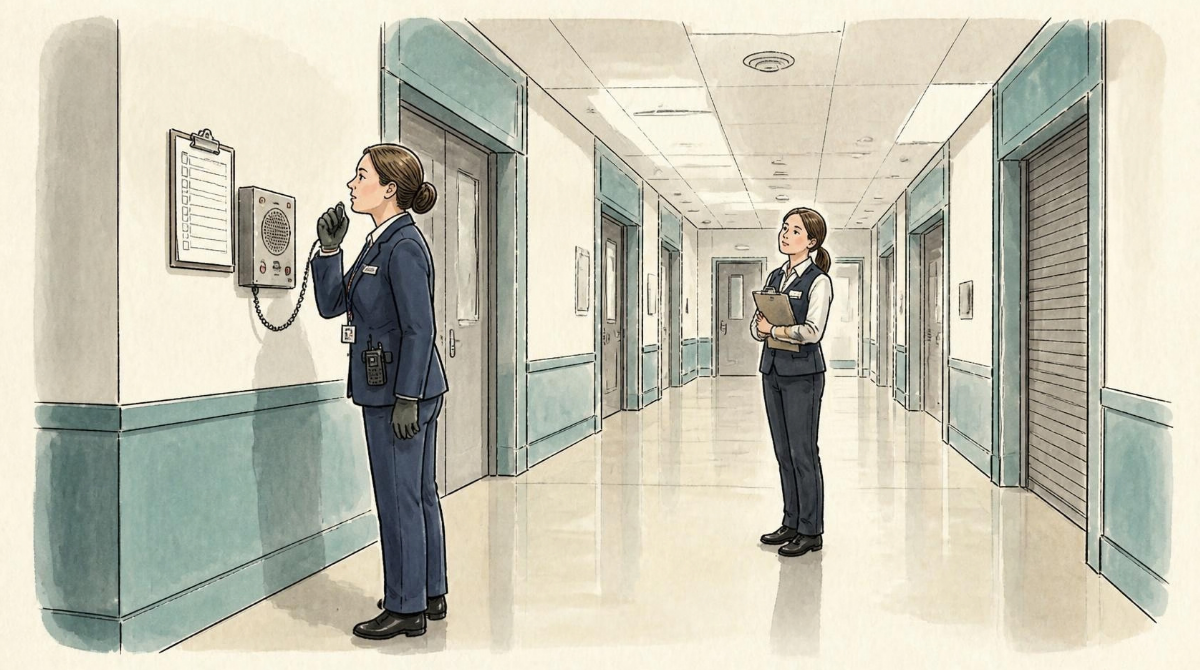
Every piece of that furniture assumes a trained person will stand there and talk.
The standard also says who should make sure of it. A single named member of the premises management should be appointed to supervise the system. The first activity listed under that role is that operators are trained regularly, with microphone technique first on the training list (Clause 42 a)). The commentary is plain: "Operator training is also an important role for the premises management".
The duty is written down. It arrives as one line.
So the duty has a holder. The difficulty is how it reaches the building.
The microphone is specified in Clause 17, around page 24 of the standard. The training duty sits in Section 6, under user responsibilities, about forty pages later. Between the two comes the handover. Among the checks the installer asks the purchaser to make before acceptance are two that matter here. Enough of the user's people have been trained, emergency microphone included. And the named manager has been told what Clause 42 asks of them (37.2 h) and i)).
Everybody does exactly what the standard asks of them. And a duty written as a recurring one reaches the building as one confirmation, given once.
That is the mistake worth naming, and it belongs to the structure rather than to anybody in it. The default most buildings inherit treats the emergency microphone as a commissioning item, proved and signed off, rather than an operational one, practised and kept ready.
Three things to take to whoever writes the procedure
A message library is a plan, and for fire it is the right plan, because fire follows rules and never studies the response.
An attack is designed to beat a plan. The predictability that makes a library work against a hazard is what makes it legible to an adversary, and the national guidance lists exactly what a recording cannot do.
So the emergency microphone is the primary control. BS 5839-8 already calls it ongoing control, builds the operator a lectern and names who keeps operators trained. In practice, that duty reaches most buildings as one line at handover.
The poker machine won when no single bet gave its cards away. A message library is a hand the whole building has seen before. The trained voice at the microphone is the one part of the system that can play the hand actually being dealt.
One question, before somebody else asks it
Forward this to whoever is writing your Martyn's Law procedures, which in a large venue is usually the security manager. The Terrorism (Protection of Premises) Act 2025, known as Martyn's Law, asks qualifying venues for procedures that include providing information to people on the premises (s.5(3)(d)). The Security Industry Authority (SIA), which will regulate it, expects the Act to come into force in spring 2027. Whoever writes that procedure will need to be able to say who speaks. Answering it now costs a conversation.
Then ask your maintenance provider one question, which accuses nobody. At the next service visit, can the people who would use the emergency microphone spend ten minutes speaking into it at a quiet hour, with somebody listening out in the building? The standard's own commentary on routine testing says testing is an opportunity for operators to practise making emergency broadcasts (commentary on Clause 39).
If you would like a hand making those ten minutes count, that is work we do. But the question is yours, and you do not need us to ask it.

Next in the series: the certificate measures the half of the chain with no person in it, starting from the microphone training guide that BS 5839-8 itself names (18.6, Note 2), published by the Institute of Sound, Communications and Visual Engineers (ISCVE).
Where this comes from
We paraphrase the standards and guidance; we do not reproduce their text. Quotations are short and limited to one per source.
- BS 5839-8:2023, code of practice for the design, installation, commissioning and maintenance of voice alarm systems. British Standards Institution (BSI). Commentary on Clause 17; Clause 17.1 and Figures 1 and 2; Clause 18.6 and Note 2; Clause 37.2 h) and i); Clause 39.5; Clause 42, its commentary and 42 a). Not public; our own-words explanation: https://proaudium.com/standards/bs-5839-8/
- Guide to Safety at Sports Grounds, 6th edition (the Green Guide). Sports Grounds Safety Authority (SGSA), 2018. Preface; 1.3; 3.15 and 3.15 d); Figure 3; 16.19 (introduction), 16.19 c) and 16.19 e). https://sgsa.org.uk/
- Marauding Terrorist Attacks, Supplementary Guidance: Announcements. Centre for the Protection of National Infrastructure (CPNI, now the National Protective Security Authority), Crown copyright 2018, published on ProtectUK. Pages 5 and 7. https://www.protectuk.police.uk/sites/default/files/2021-12/MTA%20Guidance%20Announcements.pdf
- Terrorism (Protection of Premises) Act 2025, section 5(3). legislation.gov.uk. https://www.legislation.gov.uk/ukpga/2025/10/section/5
- Understanding Martyn's Law and the SIA's role as regulator. Security Industry Authority, GOV.UK. https://www.gov.uk/guidance/understanding-martyns-law-and-the-sias-role-as-regulator
- Mastering the Game: a history of computer chess (Deep Blue, 1997). Computer History Museum. https://www.computerhistory.org/chess/
- Moravčík and others, DeepStack: Expert-level artificial intelligence in heads-up no-limit poker. Science 356, 508–513 (2017). https://doi.org/10.1126/science.aam6960
- Brown and Sandholm, Superhuman AI for heads-up no-limit poker: Libratus beats top professionals. Science 359, 418–424 (2018). https://doi.org/10.1126/science.aao1733